

Thursday, May 27, 2010

In my free time I've been perusing the archives of the New Yorker for interesting articles, and thought I'd mention one I really enjoyed: it's from 2001 and discusses the history, science, ethics, and philosophical meaning of 'brain death' and organ donation. It's thought provoking, and one of the better summaries of the issues I've seen outside of the medical literature. And, like all good reporting, it discusses the issues through the lens of how it impacts real people/families. Good stuff.
Thursday, May 27, 2010
Tuesday, May 11, 2010

Researchers in Melbourne, Australia conducted a single institution prospective randomized controlled trial to investigate the impact of this advance care planning (ACP) intervention, (Respecting Patient Choices) on end of life care in older patients. BMJ publishes the results.
The intervention was delivered in a hospital setting primarily by a nurse or allied health worker who conducted a conversation to evoke the patient's goals, values, and beliefs, and to discuss and document their future choices about health care. Family members, especially potential surrogates, were encouraged to participate. The creation of advance directive documents was encouraged. In this study, the discussions lasted a median of 60 minutes spanning 1-3 visits. The intervention appears similar to POLST programs in the United States.
The participants included 309 medical inpatients aged 80 or more who were followed for six months or until the time of death. Of the 871 patients screened, reasons for ineligibility included a lack of decision making capacity (n=368), expected death during the hospitalization, previous advance care planning, no relative, non-English speaking patients, and the six patients who refused to participate.
At the time of enrollment, intervention and control groups were similar with respect to age (median 84-85), reason for hospital admission, code status, presence of appointed surrogate, and overall preference for life prolonging treatment. There seemed to be a trend towards having more males in the intervention group (54% vs 41%), but p values aren't reported.
Of the 154 patients assigned to the intervention group, the ACP intervention was delivered to 125 (81%). Of those receiving the intervention, 70 completed a written document and 38 expressed wishes verbally (which were then recorded by the facilitator for chart documentation).
The primary outcome examined was the proportion of patients who died at six months and whose end of life wishes were known and respected by their doctors. Compliance was determined by review of patients' charts after death to identify any documentation of patients' wishes, what type of care patients received, and how the patient's wishes impacted medical decisions. It was determined that of 25/29 patients who died in the intervention group, wishes were documented and followed versus 8/27 in the control group (p<0.001).
Yes, six month mortality was...ahem... no different between the two groups.
Even with attempts at blinding to intervention, it was probably evident upon chart review which patients had received the intervention. Whether this is problematic becomes irrelevant in my mind after reviewing some of the secondary outcomes:
- Reduced risk of PTSD in survivors as evidenced by a reduced Impact of Events Scale scores in intervention group family members (including 0% vs 15% who had scores >30, which places them at higher risk of developing post-traumatic stress disorder, p 0.03)
- Reduced Hospital Anxiety and Depression Scale scores (including 0% in intervention group having a depression or anxiety score >8, which indicates clinically significant depression or anxiety, vs. 30% and 20%, respectively, in the control group).
- No patients died in ICU in intervention group vs. four patients in control group. Otherwise, the intervention didn't significantly impact place of death (hospital vs. home vs. palliative care/hospice setting).
- Family members reported greater satisfaction in a survey regarding the patient's "quality of death" (83% very satisfied in the intervention group vs. 48% in control group).
The secondary outcomes are quite reminiscent of the French ICU study on physician-family communication in the ICU that showed a reduction in risk of PTSD, anxiety, and depression in family members in the intervention group. (See Drew's commentary on that study here.) When combined with the many recent Coping with Cancer study results and the fact that results are now coming in from a variety of countries (US, France, now Australia), we should be confident in these secondary outcomes.
The fact that this is not a physician-led intervention should be highlighted. Physicians were drawn into the discussions to help clarify diagnosis, treatment options, and prognosis, but they were not central to the process. This is an important consideration as we confront workforce issues in palliative care and is an example of a "disruptive innovation" in medicine. By no means does this diminish physician involvement in expert palliative care teams nor does it relieve other physicians of their duty to be mindful of advance care planning.
Also notable is that this is not a primary care, office based intervention. It makes sense in some ways that the hospital would be the locus for this type of intervention rather than an office. Patients are captive in terms of having time to spend thinking about this and they are also more likely to see the importance of it (ie in an office, "why are you bothering me with this now? I'm just here for a cold.") Family members are more likely to be around in the hospital. Patients who are most likely to benefit from the intervention are "batched" in the hospital making it easier for those applying the intervention.
Only about 1/6 of patients had died by the six month mark. I'd be quite interested to know if the results hold as a greater proportion of patients die. If so, it only strengthens the above conclusions in my mind. If not, it would be interesting to know why (patient preferences changed? conversations need to be reiterated periodically?)
In the article's conclusion, the authors discuss the fact that advance directives were once much ballyhooed and more recently have been derided as ineffective at changing care at the end of life. They propose reasons why their intervention may be more effective than other previous attempts:
"We specifically focused on a model with five key elements identified by others as crucial to successful advance care planning: trained facilitators, patient centred discussions, involvement of family in discussions, correctly filed documentation, and systematic education of doctors.....Four of these five key elements were absent from the SUPPORT study, a project that relied on a research nurse to relay information verbally to the treating doctor about a patient’s preference for cardiopulmonary resuscitation, but which did not facilitate patient centred discussions, involve the patient’s surrogate, and ensure that the treating doctor was aware of the patient’s advance care plan when end of life decisions were made."Should hospitals implement programs like this? If so, what role should palliative care teams play in developing and implementing such programs? The palliative care team is a natural home for the direction of interventions like this--these conversations are the bread and butter of our daily work, although the patient population we see is generally sicker than the population included in this study. An intervention like this may represent an opportunity for earlier formal palliative care involvement (through triggers) versus an opportunity to insert palliative principles into the patient's care through separate but related programs. Physician and non-physician leaders alike can play an integral role in the development of programs and the training of other health care professionals to conduct these conversations (without needing to insert ourselves into every advance care planning event, which is, of course, impossible). We'll still be needed for the more complex scenarios, no doubt.
A number of possibilities exist to incentivize hospitals/providers to institute interventions like this. For instance, I wonder if there's an opportunity to include this somehow in the "national pilot program on payment bundling" (included in the health care reform bill, PPACA, Sec. 3023). See Dr. Brad Stuart's recent commentary at Geripal on issues related to health care reform and palliative care.
Many locales throughout the United States that have implemented POLST interventions, and I don't practice in one of them. Feel free to leave any ideas you have below, especially if I'm missing some major demonstration or pilot project.
See also Alex Smith's thoughtful commentary on this and a related article at Geripal.
Tuesday, May 11, 2010
Friday, May 7, 2010
Research by The RAND Corporation quantified some of the overuse: 20-40 percent of some surgical procedures are performed on patients who cannot, on scientific grounds, be expected to benefit from them (Leape et al. 1991). - From Don Berwick's Eisenberg lecture, April 2005
According to the American College of Physicians (ACP) 2009 policy paper, Controlling Health Care Costs While Promoting the Best Possible Health Outcomes, the Congressional Budget Office estimates that 5% of the American gross domestic product (roughly $700 billion per year) is spent on medical tests and proceduresthat do not improve health outcomes. (Introduction to interview with Steven Weinberger, MD, FACP - on Medscape)
- One physician pointed to the small improvements each day: the wounds were healing, his face less swollen, cardiac function improving. His honest perspective was that he was getting better, and could continue to improve to leave the hospital. This physician treasured life over all else. In the words of Dr. Epstein's article referred to by Dr. Levy in his blog "Running a hospital:"
"The Role of the Physician in the Preservation of Life." Q J Med 2007; 100:585–589.
That, however, what he missed was meaning of the next part of Dr. Epstein's speech -
We physicians belong to an ancient profession, standing apart from all others in its primary concern and respect for human life and its enmity to death. And in the long run, that attitude of the profession may be as important to society as any miracle that modern technical medicine can perform.The fact is that for all our talk and our science, we do only a little. Life cannot be prolonged indefinitely, and death comes at last. But the little we can do has an importance that transcends the patient, for it carries a message to all our patients and to the world: Human beings are important.
- The other physician saw a very different picture: a young man, an athlete and artist who would never return to his previous vigorous self and should he survive this hospitalization (a big if) would likely remain on life-support for his remaining years would definitely always be completely dependent for all activities of daily living, unable to carry on a conversation. He saw the ongoing aggressive life-sustaining interventions as possible overuse, given the dismal outcome.
Harm from overuse is not merely harm to the patient and family (providing risky or painful procedures that have little to no benefit - principle of beneficence and non-maleficense) society (cost, burden - from the principle of justice), but also may harm staff: physicians, nurses, other caregivers. In some settings: test after test, procedure following procedure in a patient with progressive end-stage disease who remains minimally interactive but winces to the interventions. One physician ordering this, while others are the ones doing it, protesting as they do, questioning the rationale and the harm with perceived little-to-no benefit, as nurses pick up the pieces. Nurses, resident physicians, and attending physicians have spoken to me of their sense of struggle, their inclination to avoid patients to whom they are "forced" to provide care they see as not having benefit but instead harm. For the ordering physician, the drive may indeed be patient preference, or perhaps that personal and professional commitment to valuing life and fighting of its enemy - i.e. death.
One of our roles as the palliative care clinician or team-member, is to navigate in this world of uncertainty. To support families struggling as they see the patient slowly, ever-so-slowly die as more and more is done to prevent or slow down the death per their request, while supporting the healthcare team who struggles with the procedures that seem to have little to offer, while supporting and watching with the physician who is also doing all he or she can to keep this person, their patient alive - as he or she believes we can clinicians are called to do.
I think physicians fall in all areas of believe around these topics - influenced, of course, by personal values and education. I remember when I was a medical student meeting another med student at a wedding. On his way to the wedding he had seen a massive accident with multiple deaths. He told me that there he met our shared enemy - death. At that moment, I began to believe that there are two general places where people fall - on one end of the extreme: death the enemy, on the other, suffering the enemy. At risk of influencing this readership, I will share that in my mind, I believe that our call as physicians (and nurses, and all in healthcare field) is to prevent premature or preventable death, but the primary role - as Eric Cassell so eloquently wrote in numerous articles, is to alleviate suffering - in all its manifestations.
Friday, May 7, 2010
Wednesday, May 5, 2010
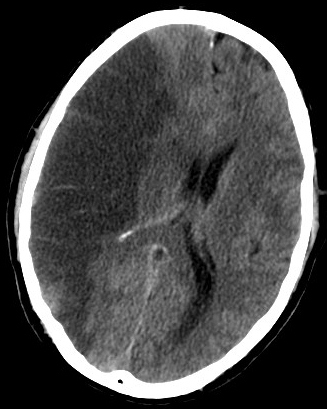
Image from Wikipedia.
 Finley Caulfield A, Gabler L, Lansberg MG, Eyngorn I, Mlynash M, Buckwalter MS, Venkatasubramanian C, & Wijman CA (2010). Outcome prediction in mechanically ventilated neurologic patients by junior neurointensivists. Neurology, 74 (14), 1096-101 PMID: 20368630
Wednesday, May 5, 2010
As a follow up for today's top-post, some more floundering about prognosis in brain injuries, and yes this one is for the progno-wonks out there.
Neurology also has an article looking at the prognostic importance of bilateral absence of the N20 response of median nerve somatosensory evoked potentials for patients with hypoxic-ischemic encephalopathy (anoxic brain injury) who have undergone therapeutic hypothermia.
Some background (although this NEJM review is the best place to go for a quick summary) on why I'm even mentioning this. Absence of the N20 response of median nerve SSEPs more than 24 hours after a cardiac arrest has been reported in multiple studies to indicate a uniformly poor neurologic prognosis (comatose patients after cardiac arrest who have these SSEP findings have uniformly poor outcomes), and it's become a well-established marker (among several) to identify patients with essentially no chance of a good neurologic recovery (see today's other post for more about 'good neurologic recovery').
In the last several years therapeutic hypothermia has been widely adopted for patients who survive initial resuscitative efforts after an arrest (essentially patients are cooled to ~32 deg. C for 24 hours - this is thought to attenuate some of the brain damage that occurs during/after an arrest and has been shown to improve neurologic recovery). Most of the research on prognosis for comatose patients after cardiac arrest was done before hypothermia was adopted, so there's some concern that previously established prognostic criteria are no longer valid (or at least not as powerfully predictive). See for instance this study, which attempts to investigate whether absent SSEPs still invariably predicts a poor outcome for patients who undergo hypothermia (it indicates they do).
The current article, which is a retrospective case series from a single German ICU in which they looked at all patients who underwent hypothermia and had SSEP measurement performed, presents data about two patients who suggest this isn't necessarily the case. Of 36 patients with bilateral absent N20 responses, a 43 year old (who had absent N20 responses at day 3 after his arrest) went on to have a normal cognitive recovery (so much so that apparently he went on to resume drinking and they were able to measure SSEPs 18 months later when he was hospitalized and in alcohol withdrawal - a very sad detail they shared - he had recovered N20 responses at that measurement). (They also report on a patient who had abnormal/barely detectable N20 responses who went on to have a normal cognitive recovery).
35 out of 36 patients with absent N20s did not recover, despite hypothermia. (While that makes 97%, one should be cautious; this is a retrospective case series and it's inappropriate to establish event rates from this study design.) One did.
My suspicion is that we will be seeing similar findings for other established 'uniformly bad' prognostic indicators in anoxic injuries. It always seemed, in a perverse way, too good to be true - that there were not just one but several findings which implied, based on all the available research, that if a patient had one or more of them they have essentially no chance of recovery. It will not be that these markers are worthless - they still will be (and this series supports it) - evidence of devastating injury with slim chance of recovery, but not some sort of 100%/clean cut/no questions asked evidence. The world's too messy for that, especially when it comes to brain injuries.
I'm curious as to whether anyone is seeing this used in clinical practice, and having conversations with colleagues about the effect of hypothermia protocols on how and when to examine patients and perform tests (for prognostic purposes), and how and when to talk with families about what we are concluding?
Palliative Care Grand Rounds is up at the greatest blog written by a law professor about medical ethics and decision making with life threatening illness, "Medical Futility" by Thaddeus Pope, J.D., Ph.D. He cranks out a ton of great information on his blog featuring very interesting court cases. His grand rounds post is a classic covering many great hospice and palliative care blogs.
Go comment over at Medical Futility and seek out the other blog posts featured in Grand Rounds. Share it with your friends on Facebook, Twitter and your IDT.
As for Thaddeus' blog, if you EVER give a talk on Medical Futility or Ethics and DON'T reference/highlight his blog, I won't consider you to be an expert who knows what they are talking about. (Redundant last point, but worth it.)
Tuesday, April 27, 2010
Back in January we posted a story about the death of Judy Chamberlin, the blogger/activist who wrote about a blog all about her 13 months on hospice. This week two more people died who lived their illness and lives very publicly through blogging and social media. With the profound temporal proximtiy of the deaths of bloggers Eva Markvoor (Blog: 65 Red Roses) and Alicia Parlette (Blog: Alicia's Story). CNN published a great article talking about Eva and also mentioned a two other bloggers who died: Miles Levin and Michelle Lynn Mayer.

 I believe this younger generation who has a more open access approach towards their social life may be a strong force in changing the narratives of medicine, disease, health and dying. They may not reach everyone with their story, but because they are heavily networked you only need to a 100-200 widely read blogs to start seeing a big impact. While the effect starts local, it soon spreads regionally and eventually globally because of the international reach of the internet. And when taken together they may have a wider reach than books like the upcoming Passages in Caregiving or Two Weeks of Life: A Memoir of Love, Death and Politics.
- EASY TO DO: Relatively low impact so when you feel sick you can still send out a tweet or record a video.
- ACCESSIBLE: Can be done from mobile platforms or with increasingly accessible internet in hospitals (unless your hospital is so short-sighted as to block sites like Facebook from public wi-fi cutting off patients from their social networks. Palliative care people should advocate for any social media site blocking to end as holistic patients care)
- FEEDBACK: when you are sick online communities usually rally with words of support and love, just what someone who is sick may be looking for.
- WIDE REACH: when the network starts to work for you the spread of your story can be viral
- Do you know if your patients or families are blogging?
- If so, did they tell you or did you find it?
- What are they writing about hospice and palliative care issues?
- What if a patient wanted to interview for their blog?
- Should we encourage or share stories of our patients using social media so that others may see the risks and benefits?
- How should we as professionals learn from these open looks into a patient's life?
- Will I blog when I am dying? (I think I will, but who knows how I will feel?)
Tuesday, April 27, 2010
Here are previous posts in the series:
- January 2006
- February 2006 (Soon to be published)
- March 2006
- Drew blogs about the 'terrible choice' for patients who elect hospice to forego any curative interventions and what level of burden they would be comfortable with.
- Will the new tanning tax in the health care reform bill have any effect on chronic opioid use? Here is the one article that might give you a hint.
- In four years the FDA still has not heard my plea to add "Indications and Methods for Discontinuation" as a category in every medication insert.
- A good one to discuss with your favorite chaplain: Does intercessory prayer help or harm CABG patients?
- Should we have more open-access to medical journals? NEJM and Drew have a little discussion.
- Opioid battle royal! Muscular morphine versus Oxycodone the Obliterator in the Visceral pain challenge!
- The BBC had a feature on 'How to Have a Good Death.' Sadly the main link is broken, but the other links all work dandy in this post.
Here are the posts from the Arts and Humanities blog from the month of April in case you missed some:
- Amber Wollesen reviews the recent HBO premiere of You Don't Know Jack featuring the pro-hastened death enthusiast Jack Kevorkian.
- An interview with blogger and poet Susan W. Reynolds about grief and growth through art by Amy Clarkson
- No hospice or palliative care advocate should miss this song: "I Don't Want to Die (In the Hospital)" by Conor Oberst. So much to think about and analyze that Amber gives you a head start.
- Amy continues to amaze me with her analysis of classical pieces and understanding the history of the composer with her post about Edvard Grieg's Ballade in G-minor.
Tuesday, April 20, 2010
[Edit 9/9/10: Welcome New York Times Readers! Please feel free to leave a comment and let us know you are here. And if you are looking for more surgical related posts, click here. For first-time readers of Pallimed check out our FAQ. And lastly you may be interested in our Arts & Humanities sister blog. - Sinclair]
An 85 year old woman with hypertension and ischemic cardiomyopathy presents to the emergency room late one night with severe abdominal pain. She is found to have a large, and leaking, abdominal aortic aneurysm. The on-call vascular surgeon comes in from home in the middle of the night and has a half-hour long conversation with the patient and her children about attempting an operative repair. The surgeon knows the chances of the patient surviving the immediate surgery aren't great, perhaps 60%, and the post-operative period will likely be rocky - days in the ICU, maybe longer, with a good chance of needing mechanical ventilation for that long or longer, not to mention acute kidney injury, need for dialysis, and stroke. The alternative is an almost certain death for the patient within a day or two, although the patient can be made very comfortable. The patient is told all of this, agrees to the procedure, and 3 days later is still ventilated, anuric, and needs CVVH (continuous hemodialysis). Her family at this point asks, insists, that dialysis not be started and the patient be removed from the ventilator and allowed to die comfortably. 'She wouldn't want any of this.' You, the palliative consultant, get the consult call from the SICU (surgery intensive care unit) case manager, because the surgeon is so upset and angry this is happening she couldn't bring herself to call you herself.*
Sound familiar?
Critical Care Medicine has a fascinating qualitative study about surgeons and end of life care which speaks directly to this, and similar, situation. It's an excellent paper for the teaching file, particularly for fellows who don't have surgical backgrounds (which I assume is most, but thankfully not all, HPM (hospice and palliative medicine fellows these days).
The paper presents a small qualitative study of 10 physicians (mostly surgeons; a few non-surgeons who do extensive work in SICUs) at two institutions who participate in high-risk procedures, and involves extensive open-ended interviews about end of life care post-operatively, and attitudes towards advance directives, based on specialty specific cases presented to the surgeons (cases which present similar scenarios as far as I can tell to the one I described above). A grounded theory approach was used to establish and describe the themes that emerge. Most of the paper simply describes those themes.
The major theme they identify is described as such:
Respondents described a complicated relationship involving negotiation with patients who require high-risk surgical procedures. According to physicians, this interaction creates an informal contract between the surgeon and patient in which the patient not only consents to the operative procedure, but commits to the postoperative surgical care anticipated by the surgeon. We have named this implicitly understood contract “surgical buy-in.”What they describe is that the surgeons either feel an implicit contract exists between the patient and the surgeon that if the surgeon is going to attempt this risky procedure, and that the patient consents to this, that they are consenting to (what generally seems to be an ill-defined) post-operative period in which essentially the surgeon decides what is necessary and appropriate care/treatments. While not actually stated in the paper, my sense is that there is an affinity between the reality that intraoperatively the surgeon has tremendous latitude in deciding how to proceed to make the surgery successful (you don't consent the patient mid-operation about whether or not to ligate the hypogastric artery), and the latitude they feel is necessary to ensure the success of the post-operative period. It's a 'package deal' (this language is used by a subject).
The surgeons described that part of the informed consent process for the surgery involves this, although it seems that at times this is frequently implicit (my sense here is that the expectation is that if the surgeon describes what could happen post-operatively and the patient still agrees to the procedure, then there is an implicit consent/agreement to all the post-operative care that the surgeon feels is necessary to keep the patient alive). The length of time needed post-operatively also does not seem to be explicitly defined by the surgeons in this process (which seems very understandable to an extent - the distinction between 7 days and 8, or 14 and 21, are arbitrary and in reality are patient-specific, and dependent on what actual complications occur, etc. etc.).
They also describe the surgeons' description of grief, guilt, frustration, and culpability when these events happen. There is a distinct sense of betrayal as well - that the surgeon told the patient this could happen, the patient agreed to take the risks, and when things don't go well immediately, the patient (or family) wants to stop, even when the surgeon thinks there is a chance s/he could pull the patient through. A key quote:
Respondents described situations in which requests for limiting postoperative care were denied. Surgeons' rationale for this course was based on the patient's potential for recovery: “For example, you know some people get pneumonia, but 90% are able to get through it and get off the ventilator and . . . that is sort of a bump in the road to that, and from my point of view you have to be willing to endure that on some level if we think you are recoverable.” Surgeons noted that this approach was paternalistic and even might be contrary to wishes expressed in the patient's AD but felt that the patient's potential for recovery as well as the preoperative negotiation permitted the continuation of aggressive support.
In my experiences with these situations the sense of betrayal and self-doubt are very acute for the surgeons. Colleagues have described to me acute feelings of causing harm to a patient: putting them through a major procedure and the post-operative care, for 'nothing,' when they could have just made the patient comfortable in the first place (for emergent procedures) or at least avoided the pain, cost, and human effort of an elective procedure. If they had known the post-op care would have been unacceptable to the patient they wouldn't have done the procedure in the first place - these were surgeons who were comfortable with their patients declining life-saving operations (they enact appropriate symptom-directed treatment and call the palliative care team) - and didn't feel like they were pressuring their patients into operations, or hiding from them what the post-operative course could involve.
I think it's a very different perspective from what our patients/families feel in these situations (I'm speaking here about personal experience as a palliative consultant, so I should acknowledge that I'm describing a self-selected group of patients/families). Most of the time I've witnessed these events the patients/families are grateful: they knew it was a long-shot, the doctors gave it their best shot, Mom knew there was a chance this would happen but was hoping it wouldn't, and it's ok that it didn't work out, now please can you make sure that Mom doesn't get a tracheostomy? The 'problem' per se is not that the patient didn't know the risks, it was that they agreed to the surgery hoping none of that would happen. And, yes now I'm introducing a boxing metaphor, the idea of going 'one or two rounds' then throwing in the towel is just plain fine with the patient/family. It is of course not fine with the surgeon, who thought the patient was agreeing to a lot more, and may not have decided to proceed with the operation in the first place knowing that there was a 2 round limit.
It's a very different perspective than what we (and I'm not completely sure how I'd define what I mean by 'we' there - internists, family docs, palliative clinicians, etc.) bring to end of life situations. Patient gets pneumonia and respiratory failure, wants to be full code and agrees to ICU level care, goes to the unit, gets intubated, and 10 days later when he can't be weaned from the vent, the patient or family says 'no he'd never want this, he wouldn't want a tracheostomy or gastrostomy tube, unhook him and make him comfortable.' Generally most of us are just fine with this, we feel we did our best, patient didn't get any better, trach/PEGs suck, and even if there's a chance he'll live he has the right to say no to this. It is very different for surgical patients, perhaps because what happens is a consequence of the surgery (at least from one perspective). In addition, I think this is due to a sense of deep personal responsibility that most non-surgeons don't have, and can't have (although as I've been thinking about this since reading the paper I wonder if there are similarities here with stem cell transplanters/BMT docs).
I have a distinct memory of one of my attendings, early on in my palliative fellowship, talking with me about surgeons. Those of us who didn't go through surgical training tend to think of surgeons as some sort of different species of physician: there's a stereotype of the egotistical, cowboy-hero surgeon who'll never give up, is unrealistic about 'his' patients' chances of living through the surgery and recovery, etc. (Obviously not everyone feels this way about surgeons, but I certainly went through my residency internalizing some similar caricature of my surgical colleagues). My attending told me something like 'Surgeons have a bond with their patients that is much stronger than internists. If you cut someone open, it changes your relationship with the patient in a way that internists just don't have.' I thought to myself at the time that that was really weird. Surgeons are cold heartless scapel jockeys - how could they have a bond deeper than my patient-centered, humanistic, whole-person approach? Well like a good fellow I remembered what he said, and slowly came to realize he was right.
Ignoring any argument about whether this bond/relationship is any qualitatively 'deeper' or 'better', or if this applies to all surgeons etc. (because clearly the humanistic patient-centered approach doesn't apply to all non-surgeons), let's just agree that it is different and different in a way that's important to understand, and appreciate, and respect in our role as palliative consultants. I think I entered palliative care training not understanding, and certainly not respecting, my surgical colleagues' different set of challenges, passions, and boundary issues, and I've come over the years to enjoy working with surgeons really more than any other specialty that consults me. The 'challenges' and 'boundary issues' can be pretty intense, but they're at least more interesting than internist X not wanting to tell patient Y that their end-stage-dyspnea at rest-20m 6 minute walk test-COPD is a terminal illness because it might make the patient cry and how can you be sure anyway?
I've probably broken some blog etiquette by writing a post this long, so I'm not going to talk about how these situations can be prevented (or if they can be; part of me doubts they can, at least for emergent procedures), or how one walks the thin line as a consultant in these situations (advocating for a patient, but also responding to a devastated, or disappointed, or angry colleague) - please feel free to discuss this in the comments.
*This is not a description of a real case I've encountered, although I've seen variations of these events frequently, but a narration of a case similar to what it sounds like they presented in this study.
While I'm disclosing things, I should probably mention that I work with 2 of the authors of this study, and for sure know at least one subject (who told me as much).
Schwarze, M., Bradley, C., and Brasel, K. (2010). Surgical “buy-in”: The contractual relationship between surgeons and patients that influences decisions regarding life-supporting therapy* Critical Care Medicine, 38 (3), 843-848 DOI: 10.1097/CCM.0b013e3181cc466b
Tuesday, April 20, 2010

