

Sunday, May 15, 2011
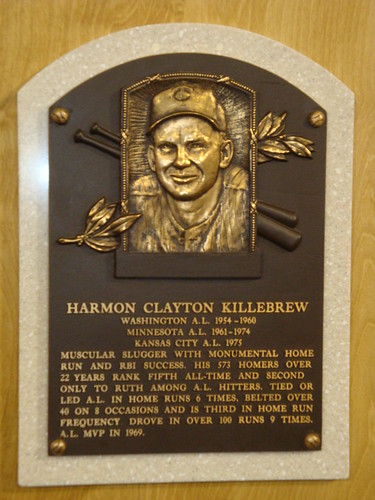
Earlier in 1971, baseball Hall of Famer Harmon Killebrew (nicknamed "The Killer" for his slugging prowess) finished his 18th season in the major leagues. That year, he won the Lou Gehrig Memorial Award which is given to players who emulate Gehrig's character both on and off the field. At the age of 35 and 36, Killebrew still produced excellent statistics playing for the Minnesota Twins in 1971 and 1972 before his production fell off in the years before his retirement in 1975.
A few days ago, I was looking for the latest scores when I found the following headline on Yahoo: "Killebrew ends fight vs cancer, looks to Hospice." (See NYT coverage here.)
Quick: What is the first thing that comes to mind when you read the first part of the sentence? I asked my wife. She thought about it a little too much, but then said, "That his cancer is cured?" The first thing that flashed into my mind when I read the headline (ignoring the hospice part) was that the article represented an obituary. (Who is the optimist in our house?) But the headline essentially quotes Killebrew from the statement he released last week:
"It is with profound sadness that I share with you that my continued battle with esophageal cancer is coming to an end. With the continued love and support of my wife, Nita, I have exhausted all options with respect to controlling this awful disease. My illness has progressed beyond my doctors' expectation of cure.
I have spent the past decade of my life promoting hospice care and educating people on its benefits. I am very comfortable taking this next step and experiencing the compassionate care that hospice provides.
I am comforted by the fact that I am surrounded by my family and friends. I thank you for the outpouring of concern, prayers and encouragement that you have shown me. I look forward to spending my final days in comfort and peace with Nita by my side."A recent Pallimed post described coverage of the decision made by Elizabeth Edwards with her doctors to stop anti-cancer treatments and more generally, how hospice and palliative care are portrayed by the media when celebrities receive those services. In this case, Killebrew is to be lauded for his approach to the transition of care and taking the time to mention that he has promoted hospice for a long time, well before he was diagnosed with cancer last year. (Partially because of the breadth of coverage related to his hospice enrollment, I haven't been able to find how he might have promoted hospice care in the past. Feel free to let me know if you know so that I can highlight this.)
Even though the Yahoo headline essentially paraphrases his statement, I still have to say that it bothers me in a couple of ways:
- Like many who practice palliative care or work with hospice, I'm ambivalent at best about the idea of using war as a metaphor for treatment of a life-limiting illness. The anti-cancer therapies do work in a war-like manner, with chemotherapy and radiation being given in an attempt to annihilate cancer cells. But what happens when those treatments don't work or aren't even possible in the first place? If you lose a battle, is it because you are personally weak, just "gave up," or met a superior enemy? Any of the three is explanations is a potential set-up for feelings of shame which then can complicate grief and social relationships once the "battle is lost."
- But even if you do buy the war metaphor, isn't there so much more to "fighting" a disease than annihilating it? For what are we "battling"? To conquer far away lands? (Which metaphorically represents extra time alive that a patient may wish for, but isn't guaranteed.) What about just preserving the integrity of the soil on which we stand in spite of the advancing enemy! In other words, aren't attempts to preserve quality of life/psychological well-being in the face of worsening cancer an important part of the strategic battle? Of course. In that sense, the "battle" never ends. As a matter of fact, Killebrew does refer to the "continued battle."
The metaphors and the mindsets go hand in hand, and one won't change without the other.
So what I wish for Mr. Killebrew is many more home runs before he hangs up his jersey.
Sunday, May 15, 2011
Wednesday, April 27, 2011
 We are fortunate enough to have two back to back contests to give our loyal Pallimed readers. We just announced our winners of our first contest and now if you were not able to go to Chicago you can enter this next contest, because you can just stay home.
The Metta Institute is giving two lucky Pallimed readers a complimentary individual registration for their May 3rd teleconference "Being with Dying" with Joan Halifax Roshi, a Zen priest, Founder and Co-Abbot of the Upaya Zen Center (Twitter: @UpayaZen) . The teleconference will focus on "Being with Dying" and the essential role of compassion in caregiving. She has worked in the area of death and dying for over thirty year and has been a keynote speaker at NHPCO and AAHPM national conferences. The cost of the teleconference is $25 for individuals or 10 for $150.
To enter for one of the two registrations you have three simple ways and each time counts as an entry:
 Add a comment to this blog post. The content is not critical but if we want to start a discussion of mindfulness and compassion in caregiving that would be topical! If a discussion really gets going that could be a lot of entries.
- Tweet about the conference/contest: Examples:
- "Hoping to win the @Pallimed Contest for the Metta Institute teleconf with @jhalifax #hpm"
- Just make sure to include the words '@Pallimed' and 'Metta' since that will be how I find your tweet for an entry!
- Yes you can follow Joan Halifax Roshi on Twitter at @jhalifax
- Comment on the Pallimed Facebook Fan Page about the contest either on the post mentioning this contest or just in general. Content is not important but again start a conversation and each comment is an entry.
Winners will be announced on the Facebook Fan Page at 3pm Central. Winners will be asked to blog about the conference and will be posted here on Pallimed to share what you learned.
Any feedback on these contest is appreciated either on this blog post or at christian@pallimed.org. No money or goods were exchanged for this contest. It is open to everyone except me including Pallimed contributors. You do not have to be a subscriber to Pallimed, nor a health care professional.
Wednesday, April 27, 2011
Thanks to all who emailed in to win. We have our winner to for one complimentary pass for a Pallimed reader to attend this meeting June 22-24th in Chicago.
Congratulations to Holly Kirkland Walsh, FNP, GN, who will attend and report back to us on what she learned from the summit.
The alternates should Holly not be able to attend have been notified by email. If you did not receive an email then you didn't win this time. But no worries we will have others.
 "Dad...this film is all the things I need you to hear."
This short film is a perfect fit for today's world filled with distractions and...hey what's that shiny object over there. Sorry.
This 4 minute film titled "THE UNSPOKEN" from Jason van Genderen was the runner up at Tropfest Australia 2011 and is more powerful than even a Hallmark commercial, more heartfelt then a torch song, and evidence that we are capable of appreciating people before they are dead and gone.
Congratulations to Jason on his recognition and thank you for giving so many people an example of what 4 minutes of talking can accomplish.
And as always check out the 81 comments and counting on YouTube for some insight in to how this affects people.
Some examples:
Thank you for this. My dad has been battling with heart disease for the past 25 years, and over the past few months he's been deteriorating quickly. it's scary to think of a world without him when he's been my whole world and my best friend. I want to tell him this, but I can't, because I don't want him to know I have such morbid thoughts and want to give him hope.
Very hard to watch as my husband passed away recently from lung cancer and I wish my husband had acknowledged he was sick, so we could have spoken those unspoken words.
Wow. I'm usually described as heartless, yet this brought me to full tears. Bravo.
Congratulations. What a precious gift. Sharing it with the world will hopefully inspire others to start communicating while they still can.
Such a great film, I can't even describe how this made me feel. I lost my grandfather 5 years ago, he teached (sic) how to be a good man in life and he gave me his sense about music, I coudn't say goodbye to him but I know he's still a part of my life in some way.
Thanks to @GroundSwellAus for the tip!
Sunday, April 24, 2011
 A few recent studies about mitigating chemotherapy complications have caught my eye and bear mentioning.
The first couple are about neurotoxic complications of chemotherapy. I've been seeing a lot of patients who have had quite severe problems from (usually chronic) peripheral neuropathies related to their chemotherapy. At least occasionally these complications are devastating - leading to very difficult to manage, disabling pain. I haven't seen this confirmed in the literature, not that I've gone looking, but my sense is that these sorts of complications are becoming more and more common, perhaps in part to expanding use of taxane-based chemotherapy, and other newer neuropathic agents like bortezomib. Despite this, there are no proven (ie, in well designed, controlled trials) analgesic therapies for painful chemotherapy associated neuropathies, at least the last time I looked at the literature (when I was editing this Fast Fact) - I haven't seen anything major come out since, but please leave comments if you know of controlled studies I'm missing.

Venlafaxine came out looking very good. 31% of patients experienced no acute neuropathy on venlafaxine, vs 5% with placebo. For those who did have symptoms, a greater proportion on venlafaxine reported greated than 50% relief in their symptoms (69% vs 26%) compared to placebo. Notably, they asked patients 3 months after the cessation of oxalaplatin-based chemotherapy; fewer patients who had received venlafaxine reported serious persistent neuropathic symptoms (0% vs 33%). All these differences achieved statistical significance (ie P less than 0.05, using 2 sided tests). Venlafaxine had more immediate side effects (nausea, vomiting, asthenia) compared to placebo. They did not measure unblinding effects, although they did mention they had difficulty meeting accrual because very quickly clinicians began perceiving venlafaxine as effective and stopped being comfortable referring patients to the study. Drop outs were similar between groups.
To me this is convincing evidence that venlafaxine reduces the incidence and severity of oxalaplatin acute neuropathy, as well as prevents and attenuates its chronic neuropathy, at a modest price of its immediate side effects. This is a small study, but I've become, lately, more of a fan of well designed small symptom studies. You want symptom interventions to be immediately effective, have a wide therapeutic index, and have very low NNTs (less than 5 patients). If you need 200 patients to show a marginal benefit it's probably not a highly effective therapy (cf the vertebroplasty trials - there was a trend towards effectiveness in one of the trials which may be 'real' - however if you need even more people to demonstrate a marginal benefit I just can't see how this is a great thing at least in the population in which it was studied).
The caveats here are to remember this is only about the prevention of oxalaplatin neurotoxicity. The physiology of neurotoxicity from other agents probably is different, and one can't conclude that because agent X prevents neuropathy with chemo Y, that it is generally effective to treat/ameliorate the pain from an established neuropathy from chemo Z. Of course it might, maybe for some patients, we don't know, and I'll probably continue to cycle through my cadre of analgesics and adjuvants, systemic and topical, hoping that something works which, you know, sometimes it does. What are others doing? Any luck with topical agents?
 |
Roxy Paine: 'Dendroid Drawings & Maquettes @ James Cohan |
The other novel intervention, which has some promise as a non-specific palliative intervention for chemotherapy induced peripheral neuropathy, is a cutaneous electrostimulation device ('a scrambler' device - not TENS, but in that ballpark). This is the only (unblinded, uncontrolled, pilot) study of it I've seen, but the magnitude of the results are certainly compelling enough, and it seemed to be effective for multiple varieties of chemotherapy induced peripheral neuropathy, that one is looking forward to the controlled trials.
The other study I noted about acute chemo complications is this one from Journal of Clinical Oncology about the natural history of paclitaxel-associated acute pain syndrome. This was something I've seen clinically now and then, but appreciated a chance of reviewing it more in depth. About 3/5 of patients reported worsening pain with/after paclitaxel dosing, which peaked on day 4. Development of the acute pain syndrome , which includes diffuse body achiness/myalgias as well as sensory symptoms like tingling & numbness, seemed to predict developing a chronic peripheral neuropathy. The authors also conclude that the characteristics of the pain syndrome argue that it is a neuropathy (acute neurotoxic symptoms) despite its common manifestation of whole body myalgias which could also suggest a myopathy/myositis.
And finally, gabapentin was studied in a randomized, blinded, placebo controlled trial in the prevention of chemotherapy induced nausea and vomiting (added to ondansetron, dexamethasone, and ranitidine - this was a Brazilian-based trial group). Patients received gabapentin for 5 days before and 5 days after chemotherapy (or placebo). Patients receiving gabapentin had lower rates of both acute and delayed nausea & vomiting. I've never used gabapentin for nausea (either its prevention or treatment): anyone have any experience with this?
 J. P. Durand, G. Deplanque, V. Montheil, J. M. Gornet, F. Scotte, O. Mir, A. Cessot, R. Coriat, E. Raymond, E. Mitry, P. Herait, Y. Yataghene, and F. Goldwasser (2011). Efficacy of venlafaxine for the prevention and relief of oxaliplatin-induced acute neurotoxicity: results of EFFOX, a randomized, double-blind, placebo-controlled phase III trial Journal of Clinical Oncology : 10.1093/annonc/mdr045
Smith TJ, Coyne PJ, Parker GL, Dodson P, & Ramakrishnan V (2010). Pilot trial of a patient-specific cutaneous electrostimulation device (MC5-A Calmare®) for chemotherapy-induced peripheral neuropathy. Journal of pain and symptom management, 40 (6), 883-91 PMID: 20813492
Loprinzi, C., Reeves, B., Dakhil, S., Sloan, J., Wolf, S., Burger, K., Kamal, A., Le-Lindqwister, N., Soori, G., Jaslowski, A., Novotny, P., & Lachance, D. (2011). Natural History of Paclitaxel-Associated Acute Pain Syndrome: Prospective Cohort Study NCCTG N08C1 Journal of Clinical Oncology, 29 (11), 1472-1478 DOI: 10.1200/JCO.2010.33.0308
Cruz, F., Iracema Gomes Cubero, D., Taranto, P., Lerner, T., Lera, A., Costa Miranda, M., Cunha Vieira, M., Souza Fêde, Schindler, F., Carrasco, M., Afonseca, S., Pinczowski, H., & Giglio, A. (2011). Gabapentin for the prevention of chemotherapy- induced nausea and vomiting: a pilot study Supportive Care in Cancer DOI: 10.1007/s00520-011-1138-4
Sunday, April 24, 2011
Thursday, April 21, 2011
As it's been noted on the blog before, it's safe to say we are in the midst of a transition towards increasing restrictions on our ability to prescribe opioids to our patients, although the nature of these restrictions are really just emerging**. All of this is, of course, in response to the horrifying epidemic of prescription opioid abuse - see this recent New York Times piece for a bone-chilling description of prescription opioid abuse in Appalachia.

**Yes, I actually wrote those words last night. Subsequently my inbox gets flooded with notifications that the FDA has announced its long-awaited REMS program for long-acting opioids...kind of. Press-release here, which discusses, in broad-strokes, a multi-agency strategy (beyond REMS) to help stem the epidemic. We are told the key elements of the strategy will be:
- expansion of state-based prescription drug monitoring programs
- recommending convenient and environmentally responsible ways to remove unused medications from homes
- supporting education for patients and health care providers
- reducing the number of “pill mills” and doctor-shopping through law enforcement
I'd recommend reading Stew Leavitt's analysis for a more knowledgeable discussion of the announcement.
Photo from the FDA's press-release.
Thursday, April 21, 2011

The paper begins by highlighting the familiar barriers to palliative care research: limited research funding, few personnel trained in palliative care research, difficulty in recruiting and retaining patients/subjects, methodologic issues. They also pointed out that there still isn’t a consensus taxonomy and classification system for palliative care literature (can you tell they had professional research librarians on the teams?). An issue in designing this study is the great complexity and diversity of the palliative care literature. Here’s a sentence I loved: “Unlike other disciplines, palliative care transects numerous domains.” Ever seen ‘transect’ in a palliative care paper? The number of clinical issues, populations (multiple subsets), disciplines involved, and something they didn’t mention, the diversity of publication titles, makes the task of reviewing the whole of the literature for a specific major disease class pretty overwhelming to contemplate. They admitted, in a bit of understatement, that it was a “labor intensive” project.
I’ll skip over the study methods and jump to the results. Combining the 2 periods,
- Of over 6000 articles screened 1213 were reviewed. A significant proportion of studies were excluded from this review because they involved topics such as palliative chemotherapy with survival as the primary endpoint
- 70% of papers were original studies
- 42% of the studies were published in palliative care journals while 19% appeared in oncology journals
- Over 400 journal titles had at least one palliative oncology paper.
- “The palliative oncology literature is flooded with descriptive studies when we urgently need more practice-changing analytic studies.”
- Physical symptoms, health services research and psychosocial issues were the most common topics. There were many “orphan” (under-studied) topics even under physical symptoms).
- Pediatric palliative care was “largely unexplored.”
- Providers and lay caregivers are under-studied
- The proportion of palliative care articles in the oncology literature remained below 1% and even decreased slightly, despite an increase in absolute numbers of papers.
- There was a 47% increase in original studies.
- The percent of randomized controlled trials decreased from 7% to 5%
By the way, articles in The Oncologist have recently been made freely available (again) with registration to individuals.
Hui, D., Parsons, H., Damani, S., Fulton, S., Liu, J., Evans, A., De La Cruz, M., & Bruera, E. (2011). Quantity, Design, and Scope of the Palliative Oncology Literature The Oncologist DOI: 10.1634/theoncologist.2010-0397
 In a previous blog I asked about coverage of some of the other main palliative care meetings as a new role for Pallimed. Hopefully many of you are already attending these meetings and if you are you are welcome to email me in advance and get your complimentary 'Pallimed Blogger Press Badge' in exchange for giving us a summary of what you learned while you were at the conference. Until now the Pallimed Blogger Press Badge really didn't hold much value beyond getting you into all the swankiest clubs and a Pallimed/GeriPal Party if it was being held in your city. (They only happen once per year!)
But now we are entering a new era...

In an arrangement with the World Congress, they have given us one complimentary pass for a Pallimed reader to attend this meeting June 22-24th in Chicago. Once you attend then you can report back on Pallimed with a blog post about your experience.
To be considered please email me at christian@pallimed.org with the Subject 'Pallimed Contest'. For additional consideration about how excited you would be to take this opportunity, comments on Pallimed, Facebook Fan Page and Tweets containing @Pallimed will all be considered. From all the applicants the winner and two alternates will be selected and posted on the Pallimed Facebook Fan Page and Twitter on Wednesday at noon, and posted to the blog at 10pm that evening (all times Central, because it is the best time.) From all the entries a random number generator will be used to select the winner and the two alternates.
If you are selected and end up not being able to go, I have the right at some time in the future to call you silly names in private.
Fine Print
You must be able to travel to Chicago to attend the majority of the meeting. No hotel or travel expenses will be reimbursed. No monetary reimbursement will be disbursed. No money was given to Pallimed or any of the editors, or contributors for this arrangement. This contest is open to current and past contributors
If you are interested in having a Pallimed blogger at your conference, please email christian@pallimed.org for details. Selection of conference is at the discretion of the editors.
Sunday, April 17, 2011

Updates of Ethics, Dr. Sha reviewed key articles/events in palliative care and ethics:
- The CDC takes a stand on distributive justice during influenza pandemics in allocating ventilatory support to patients. - Article: Manuel ME Pandemic Influenza: Implications for Preparation and Delivery of Critical Care Services J Intensive Care Med. Jan 10, 2011 doi:10.1177/0885066610393314
- Medical students who reflect, debrief with faculty about a death they experience, show more empathy and professionalism. - Kelly E, Nisker J. Medical students' first clinical experience of death. Med Ed 2010
- Challenging autonomy in medical decision-making in critical care settings - some advocate for increased beneficence to ameliorate the distress of surrogate decision-makers. - Curtis JR, Vincent JL. Ethics and End-of-Life care for adults in the intensive-care-unit. The Lancet, Oct 2010. doi: 10.1016/S0140-6736(10)60143-2
- Can we help the homeless complete advance directives? A study by Song and colleagues say yes! Song J, et al. Effect of an end-of-life planning intervention on the completion of advance directives in homeless persons. Ann Int Med. 2010;153:76-84.
- Other references:
- Laurey S, et al. Unresponsive wakefulness syndrome: a new name for the vegetative state or apallic syndrome. BMC Medicine. 2010; 8:68
- Powell T. Life imitates work. JAMA 2011; 305:542-43.
- PPIs are loosing favor. Why? Due to increased risk of osteoporotic fractures (from the Arch Intern Med 2010; 170(9):765-771) and *c. diff (Arch Intern Med 2010; 170:772-778, W J Gastroenterology 2010:16(28):3573-3577 Open Access PDF). For us in palliative care, the latter is more critical - especially in the hospice setting. PPIs carry a much higher risk for recurrent c. diff.
- Triptans and SSRIs may not play well together. Beware of prescribing triptans for migraines in patients on SSRIs due to increased risk of serotonin syndrome.
- Bisphosphonates may cause severe musculoskeletal pain. Patients taking oral bisphosphonates for osteoporosis had 5.6% incidence of severe musculoskeletal pain, but for those taking it weekly, the incidence increased to 20-25%. This higher incidence is also noted in monthly dosing. - This to me was of note, given the number of our patients on bisphosphonates as co-analgesics for metastatic bone pain. J Muscoloskeletal Neuronal Interact 2007; 7(2):144-148 612 Open Access PDF) -
- SSRIs may cause increased risk of UGI bleeds. - especially when given in conjunction with NSAIDs. The risk is higher in older patients. (Clin Gastroenterol Hepatol 2009;7(12):1314-1321. Aliment Pharmacol Ther 2008;27:31-40 (meta-analysis))
- Anal fissures: symptomatic relief - use Sitz baths, stool softeners and pain management. Other options include topical nitroglycerine, Botox injection, surgery.
- Cough associated with acute bronchitis: beta-agonists had little effect (although they did help wheezing); cough suppressants including codeine did little; placebo did wonders, as did honey. (Ann Intern Med 2000;133:981-991 Open Access PDF. Psychosomatic Medicine 2005;67:314-317 Open Access PDF. Arch Pediatr Adolesc Med 2007;161(12):1140-1146. Open Access PDF)
- Migraine headaches are actually often the true etiology of what many patients call sinus headaches. (Tips include - no fever, no nasal discharge, no cobble-stoning). Metoclopramide in combination with acetaminophen is as effective as triptans if patient has nausea. Otherwise, metoclopramide may potentiate effectiveness of triptans. Metoclopramide may be more effective than hydromorphone in treating severe migraine headache pain. J Pain 2008;9(1):88-94.
- Flatulence that is malodorous - the two best EBM ways to treat stinky flatulence - after stopping any drugs or food that might be the culprit (lactulose, Psyllium, PPIs) include rifaximin (Am J Gastroenterology 2006;101:326-333) and charcoal cushions (Gut 1998; 43:100-104). For over the counter remedies - there is a question as to whether bismuth subsalicylate may decrease the smell. Simethicone has no effect.
Sunday, April 17, 2011
Thursday, April 14, 2011
 This post is part of the 2011 Blog Rally for National Healthcare Decisions Day. If you have a blog please post it and leave it up on the front page through April 16th. -Ed.
Rallying to Encourage and Empower Us All to Make Our Healthcare Decisions Now for the Unknown Later…
College education. Career path. Relationships. Starting a family. Buying or selling a house. Vacations. Retirement. From the age that we’re old enough to understand, most of us are taught and accept that these are the markers in life that we plan for. However, there’s one key marker that’s all-too-often missing from this list: healthcare decision-making. Like planning for these other life events, planning for the time (or times) that we are unable to express our healthcare wishes is of the utmost importance. It is something that should be well thought out, documented and revisited at different points in life to reflect any change in our desires or family situation or the person we wish to advocate for us. Unfortunately, it is a planning point that that majority of us have missed. As a consequence patients’ families suffer the added burden of having to guess when a health crisis happens. That’s why Nathan Kottkamp founded National Healthcare Decisions Day (NHDD) back in 2008 and why this nationwide advance care planning awareness initiative is as important as ever. So this year, I’ve joined my fellow bloggers throughout the country to spread the word about the importance of advance care planning with this special NHDD edition blog.
NHDD, which happens every April 16, is a collaborative effort of national, state and community organizations as well as dedicated individual advocates committed to ensuring that adult Americans – like you and me —have the information and opportunity to communicate and document their healthcare decisions.

April 16 is rapidly approaching, so it’s time to kick the engagement effort into high gear. Here are some things you can do for yourself and your loved ones to prepare for NHDD 2011:
- Lead by example. Schedule time with your loved ones (on or before April 16) to “Have the Talk” and complete your own advance directive. There are many tools, including free forms, you can use to walk you through the process and make your wishes known; access them through the NHDD Public Resources page.
- Encourage your loved ones and friends to learn more about advance directives and to complete their advance directives. You can forward this link: http://www.nhdd.org/p/resources.html to them. Or, encourage them to find a nearby participant and attend a local NHDD event.
- Share your advance directive with your healthcare providers and make sure it is on file in the event it is needed.
Already had the conversation with your loved ones, but want to do more? Here a few suggestions to rally support for NHDD and encourage even more action:
- Like the NHDD Facebook fan page and share it with your Facebook friends
- On Twitter? Follow @NHDD and share the information with your followers, i.e. ‘Just 5 days to #NHDD, when will you #havethetalk? @NHDD can help: http://bit.ly/glff1V’
- Send an email to your friends, staff, colleagues, lodge/social club members, and/or house of worship, telling them that you are participating in NHDD and encouraging them to do the same. Share the information above with them and/or use this template email:
- April 16 is National Healthcare Decisions Day, and I hope that you will join me in taking this time to discuss and document your healthcare wishes. We all need to be prepared in the event of a health crisis, and having the talk is easier than most people think, but many of us need a little inspiration or a reminder to do it. I hope that this message and National Healthcare Decisions Day are all you need. Please mark your calendar for April 16 to have the talk with your loved ones. There are all sorts of free resources, including free advance directive forms for each of the 50 states, on the NHDD website: www.nhdd.org. Additionally, please help me spread the word with Twitter, Facebook, and LinkedIn. Advance care planning is something we ALL should do and encourage others to do, regardless of age or current health. Discussing your wishes can be one of the most important gifts you ever give your loved ones.
Thursday, April 14, 2011
