

Tuesday, January 10, 2006
December's Journal of Pain and Symptom Management has a piece examining concordance between patients' and surrogates' understanding of end of life wishes. This is a large study for the field, involving 92 hospice patients and their surrogates (mostly spouses/partners or adult children). Both were asked extensive questions regarding end of life wishes (goals, hopes, concerns, priorities, etc). Agreement between patients and their surrogates was generally poor; among other findings most surrogates misidentified most patients' top priorities.
These are the general findings, but I'll warn you that this study generated mounds of data & one really begins to wonder how best to interpret them. I'll elaborate with a little research methods/epistemology detour. 31 end of life 'preferences' were measured for the study (everything from 'pain under control,' to 'time [spent] with pets,' to avoiding 'ventilator/dialysis to prolong life.'). If the fundamental question being asked is 'how good are surrogates at knowing patients' end of life wishes?,' how does one go about interpreting the data generated from these 30 questions? Is 50% concordance between answers to the survey "good"? 75%? 90%? Who decides? How do we decide if 90% vs, say, 50% concordance between surrogates and patients is a meaningful difference upon which we should act to improve the quality of of end of life care? And does it make sense to weigh all preferences equally? Is 'time with pets' equally necessary to "good" concordance between surrogate & patient as "say goodbye to loved ones?" Probably not. That is why the authors looked at agreement between what patients and surrogates viewed as top priorities.
I am not pointing this out to criticize the study; in fact the authors are quite upfront about these problems in the paper, and there's not like there's some standard out there they can turn to. What I do think is tough to justify 'scientifically' though is that the authors decided to define concordance as agreement within 1 point of 0-10 scale (in the survey the participants rated how important they thought something was on a 0-10 scale). So if someone rated 'dying in place of one's choice' as a 9/10 in importance but their spouse rated it a 7/10 the spouse's response was considered not in agreement. This seems arbitrary and tough to justify. Obviously the authors needed to pick a cut-off somewhere, but their findings would have been even more compelling if they showed their findings were valid even using different cut-offs.
Nevertheless the overall mediocre concordance between patient and surrogate throughout the study was so consistent that the 'big message' from the study resonates loud and clear: don't assume surrogates understand patients' wishes. As a bright note, however, the authors found that concordance between patients' and surrogates' answers was significantly improved if 1) the patient thought the surrogate actually knew their preferences, and 2) the patient reported talking with surrogates about treatment preferences. Seems obvious, but in fact this is not necessarily so given that all the rest of the study's findings demonstrate people don't understand loved ones' wishes as well as they probably think they do. So it's encouraging that we actually have some evidence to say if people actually talk about this, understanding is improved. The other 'big message' then is a reminder to us clinicians to facilitate these discussions.
(There's also an article looking at a Taiwanese population, finding that families' end of life preferences for patients are usually more 'aggressive' than the patients' own wishes.)
New PC-FACS are out. My prior comments stand: superb, wish they were free to all.
I'll be blogging about a couple other pieces of Decembers JPSM later this week.
Tuesday, January 10, 2006
Thursday, January 5, 2006
The Journal of General Internal Medicine has an intriguing article about predictors of the loss of decision making capacity in demented patients. To be clear, I did not find the article intriguing because of their findings of what predicted loss of decision making capacity; that was a lot of technical neuropsychiatric stuff that I don't understand. Instead, what was intriguing was that the study followed demented patients longitudinally (over 9 months) and assessed capacity over that time. The study looked at 53 elderly people who were in a study on decision making capacity & who, during screening for the study, were found to have dementia (it's unclear whether or not they had previously been diagnosed with dementia). These 53 had mild or moderate dementia--not severe. They assessed decisionality with some battery of neuropsych testing at baseline and then at 9 months. Initially 9% of the group lacked decision making capacity; after 9 months 26% did. This is interesting for what it says about the natural history of dementia, but also for how imperative early and comprehensive advanced care planning is for those with dementia, given how rather quickly decision making capacity was lost in this population.
Thursday, January 5, 2006
The current New England Journal of Medicine has a perspectives piece by Timothy Quill and Diane Meier about the upcoming Supreme Court decision regarding the Oregon physician assisted suicide law (and whether the DEA or the state medical boards have the power to restrict physicians' use of controlled substances). Their take is that a decision in favor of the DEA will have a chilling affect on physicians' prescribing of controlled substances to dying patients, for fear of scrutiny for being involved in 'assisted suicide.' It is a chilling article and all I can say is that if the Supreme Court rules "against" the Oregon law, I hope Drs. Quill andMeier are wrong. A quote:
This type of DEA involvement in medical practice would adversely affect far more patients than those few who seek assistance with a hastened death in Oregon. If the government thus oversteps its legitimate role and expertise, allowing DEA agents, trained only to combat criminal substance abuse and diversion, to dictate to physicians what constitutes acceptable medical practice for seriously ill and dying persons, it will undermine palliative care and pain management for the much larger number of seriously ill patients in all states.
Free full-text is available.
Tuesday, January 3, 2006
BMJ has published a piece about coma prognosis for characters on soap operas (along the lines of the famous article about CPR outcomes on the TV show "ER" 10 years ago). They looked at 10 years of programs from 9 popular US soaps. I can't vouch for how good these results are as the authors were forced to use non-validated secondary sources for their findings & it appeared they came across some unusual methodological contingencies. A quote:
We included only the first episode of coma for each patient. We determined the patient's characteristics and the cause of coma by reviewing the storyline at an official or sanctioned website and resolved disagreement by consensus. When a patient had an identity change (a facial transplant in one case), we used the characteristics of the original patient for analysis.
The results are not surprising. Notably, 89% of patients recovered fully, and 86% of patients had no residual disability on the day that they recovered (except for, naturally, some amnesia). This, the authors point out, is for a population (soap opera characters) that has a remarkably high overall mortality.
They conclude: In the interests of public health, soap operas and other forms of mass media should seek to balance stories of improbable survival and recovery with compelling and compassionate stories of characters who die with comfort and dignity.
Good luck....
(BMJ annually publishes an issue devoted to unusual and unconventional papers, often--but not always--funny, & this article is from this year's. It's worth a read if you have the time.)
Tuesday, January 3, 2006
Happy New Year Pallimed readers!
Pain has an interesting article on the diurnal variation in chronic neuropathic pain. It caught my eye because I was taught, & I think many people believe, that pain tends to be worse at night. I always attributed it to people being less busy at night, with more time to notice their pain, but clearly that's just a gross assumption that may not be true at all.
The Pain article looks at data gathered from the randomized controlled trial comparing morphine to gabapentin for chronic neuropathic pain (diabetic neuropathy and postherpetic neuralgia) that was published last year in the New England Journal of Medicine. For this article they looked at the pain diaries for the patients when they weren't receiving any active therapy & found a distinct increase in pain across the day. The figure shows the diabetic neuropathy results--you can see quite vividly that the 8pm pain scores were consistently and predictably worse, by a sizable 2/10 points on the 0-10 numeric rating scale, than the 8am scores.
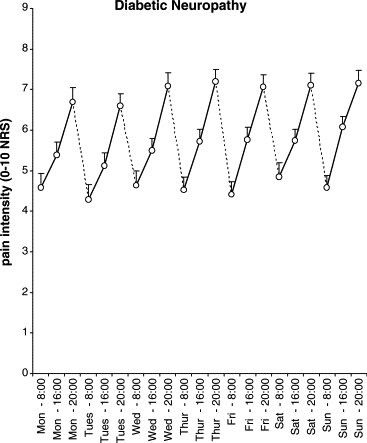
They found similar results for PHN, although the magnitude of the swing wasn't as pronounced. This pattern was preserved even when people were on active treatment. Pain scores overnight (8pm to 8am) weren't, unfortunately, recorded for the trial.
Why this happens I don't know. In their discussion, the authors make murmurings about circadian fluctuations in neurotransmitters and endorphins, and ask whether melatonin (which increases at night) is pro-nociceptive. Clearly, however, no one knows--nor is it known how significant this is outside of chronic neuropathic pain--but the figure dramatically displays how real a phenomenon this can be.
Saturday, December 24, 2005
The New York Times has an article on hope published today in their ongoing "Being a patient" series. It tries to describe the pitfalls and perils of both "false hopelessness" as well as "false hope." It's journalistic, showing "both sides of the story," and--inevitably--quotes Emily Dickinson. But it does capture pretty well what many of us confront daily.
Dr. Eric Cassell gives a good quote:
[Patients do not need] false hope that is personified in useless therapy with nontherapeutic effect.
(Typically, NY Times articles are only available--with free online registration--for about a week. Otherwise you need a pay NY Times Select subscription. If you're reading this in January, & really want this article, let me know.)
Saturday, December 24, 2005
"Respect for persons entails dialogue, perhaps even confrontation, but only to ensure honesty in each party, in the face of death."
The December Journal of Medical Ethics has an opinion piece questioning the teaching of the "Four Principles" (beneficence, non-maleficence, autonomy, and justice) to medical students. In fact, it generally savages the 4 principles all around (not so much for the ideas themselves but for the their promotion as bedrocks of ethical medical decision making). The piece smacks somewhat of a medical ethics in-fight, but the author has some choice things to say. I appreciated the article for a few reasons: 1) I whole-heartedly agree that the 4 Principles are just not very useful--when was the last time you consulted them to help you think about a difficult case? 2) "autonomy" is often misused by physicians as a way of avoiding making difficult decisions about medical care with their patients (cf. the Hastings Center Report, 3rd article, by R. Burt), & 3) for its contrarian rhetoric & use of the word "palaver."
Some highlights...
[The Four Principles] remain utterly fatuous. Let me take the two neologisms first. What does beneficence mean other than "be nice"? What does non-maleficence mean other than "don't be nasty" (however noble sounding the Hippocratic Oath)? Such heavy-sounding principles are hardly going to enlighten anybody, let alone solve ethical puzzles. After all, every time I give an injection I am harming the patient. Instead, there are perhaps two sets of genuine ethical questions that are needlessly obscured by the bureaucratic verbiage: (i) is this action really harmful, in what sense, according to what criteria, in whose judgment, is the response to the harm appropriate, etc, and (ii) is this harm justified by the quality and likelihood of the subsequent benefit? My point is: if these are the real questions, why not go straight to them, without all the palaver?
Some have claimed that the Four Principles could act as a structural framework for analysis or "a useful 'checklist' approach to bioethics for those new to the field". I would say that anybody who is morally obtuse enough to need such a checklist would not be capable of interpersonal relationships of any complexity, and certainly should not be practising medicine.
Autonomy is more philosophically robust than the first two, but it is no philosophical achievement to conclude that "X should be done because it respects the patient's autonomy". When a competent patient declares what he wants or does not want, then of course this should be respected where possible: but that's not a high blown Principle of Medical Ethics, that is how we should treat anybody. Again, the real ethical questions are unnecessarily obscured: should the patient be given what he wants when there is a doubt about whether he understands his situation and the options available? Should the patient be given what he wants when it is judged medically futile? Too much emphasis on autonomy leads to a conception of health care as merely another service to be provided to customers on demand. In this I agree with Alastair Campbell, who prefers to speak of respect for persons rather than respect for autonomy: "Respect for persons entails dialogue, perhaps even confrontation, but only to ensure honesty in each party, in the face of death".
And on this note I wish Pallimed's readers Happy Holidays & Safe Travels.
--Drew.
Friday, December 23, 2005
As the holidays come storming towards me, I haven't been posting as much, & I expect things from my end will be lax until after the new year. Thanks to Christian for picking up the slack. I can't emphasize how interesting the Hastings Center report is, and appreciate Dr. Sinclair's posts.
I wanted to briefly highlight two journal issues which have devoted a series of articles on end of life care:
First, Journal of Clinical Oncology has published 3 pieces on pediatric death & end of life care--one about end of life preferences of kids dying of cancer; one about patient and physician impressions about what constitutes quality terminal care; and the last a survey of bereaved parents regarding stress/coping/etc. What was striking about the first article (which involved interviews with 20 kids aged 10-20 years who were dying) was how similar their end of life preferences, decision making algorithms, etc. were to what I see as adults' preferences & algorithms. Top on the list was both how their disease and decisions affected family members as well as concerns about their symptoms/suffering.
The Journal of the American Osteopathic Association has published a supplement on "Holistic care for cancer pain" (Table of contents here; there's free full-text on all of these articles). There are articles on non-pharmacologic & complementary treatments of cancer pain, pharmacologic therapies, etc., as well as the American Osteopathic Association's statement on end of life care which is very reasonable.
I was greatly disappointed however by the article "Palliative care: optimizing quality of life." With a title like that, I thought it would be a nice, soft, promotional overview of the profession and patient-care model I know as 'palliative care.' Instead, we get an a section on "palliative chemotherapy" (perpetuating the confusion between non-curative but life-prolonging chemo & truly "palliative," symptom-reducing treatments...such as they are**), palliative radiotherapy, palliative surgery, and palliative interventional therapies (celiac plexus blocks and the like). All of this is swell & all of these interventions can be wonderful, but this is a very different conception of palliative care that I, & I suspect most of us, see daily--which involves help with end of life decision making, advanced care planning, grief/bereavement/spiritual support for patient and family, & a whole bunch of medical therapies for pain & symptom management. All of these, I hope, are part of "optimizing" quality of life.
I'll stop my tirade now. Maybe I'm just thrown by the title, which should instead be something like "Palliative care with the knife, needle, poison, & ray-gun."
**See here & here.
Friday, December 23, 2005
 Dr. James Hallenbeck at the VA Palo Alto has made some great online resources available for Palliative Care. He has a blog through Growthhouse, an online Palliative Care Resource center. One of his blogs talks about Palliative Care Journal Club, and he has made a available through the VA Palliative Care website 49 topics with journal references to cover most of the common Palliative Care topics. For those looking at a year-long curriculum resource or just something to read throughout the year, this is already well-developed and well-researched. I am thinking about using it in our fellowship with proper credit to Dr. Hallenbeck and the VA, of course. If you find it useful, make sure to drop him a line and let him know.
Wednesday, December 21, 2005
The free article from the Journal of Neurology, Neurosurgery and Psychiatry on prognosis of ICH-type strokes provides a good tool for use in the ICU. The development and validation of the Essen ICH Score can be useful to neurologists and palliative medicine physicians dealing with this devastating illness.
Using a functional index of daily activities called the Barthel Index (0-100, worst to best) to assess independence and functional recovery, the study followed 340 patients from stroke onset to 100 days post stroke. The Essen ICH Score is derived from 3 factors: Age, NIH-Stroke Scale (NIH-SS), and NIH-SS Level of Consciousness. The maximum Essen ICH Score is 10 with >7 indicating likely death, and <3>95 on the Barthel Index). They compared the sensitivity, specificity, Positive and Negative Predictive Value (PPV and NPV) for the Essen ICH Score, physician's prediction and the old standard prognosis scales the ICH Score and the Modified ICH score.
The major improvement with the Essen ICH Score is that it helps to predict functional recovery which the ICH score and modified ICH score never did. The PPV and NPV of the Essen ICH score to predict death is 88.7% and 81.0% and to predict functional recovery is 69.8% and 86.7%. Of note these scores are very similar to the physician's predictions. In fact, the prognosis of the physicians had a better PPV for death (93.3%) and for complete recovery (79.2%). An interesting last line of the article:
In contrast, the even higher positive predictive value of the physicians´ prediction of death may hint at a self-fulfilling prophecy.I will have to see what the three articles that were cited have to say on this matter. The self-fulfilling prophecy of prognosis and the classic physician's dilemma is one that has been written about by Christakis in a number of articles and in his book, Death Foretold.
Wednesday, December 21, 2005
