

Wednesday, April 30, 2014
“I’m going to get out of here one of these days… in a box” Jack Hall
“When you find yourself doing a life sentence, the thought of your death comes to mind. So when the prison administration started looking for guys to do volunteer work in the hospice program I said sign me up.” Glove
“When I started hospice I thought it would be about what I could give to the patient or what I could do for the patient to make them feel better. But when you do when you do what you do; the feeling you get back from then you can even describe it. I get the feeling in the inside that for once I’m somebody that nobody thought I could be” inmate hospice volunteer
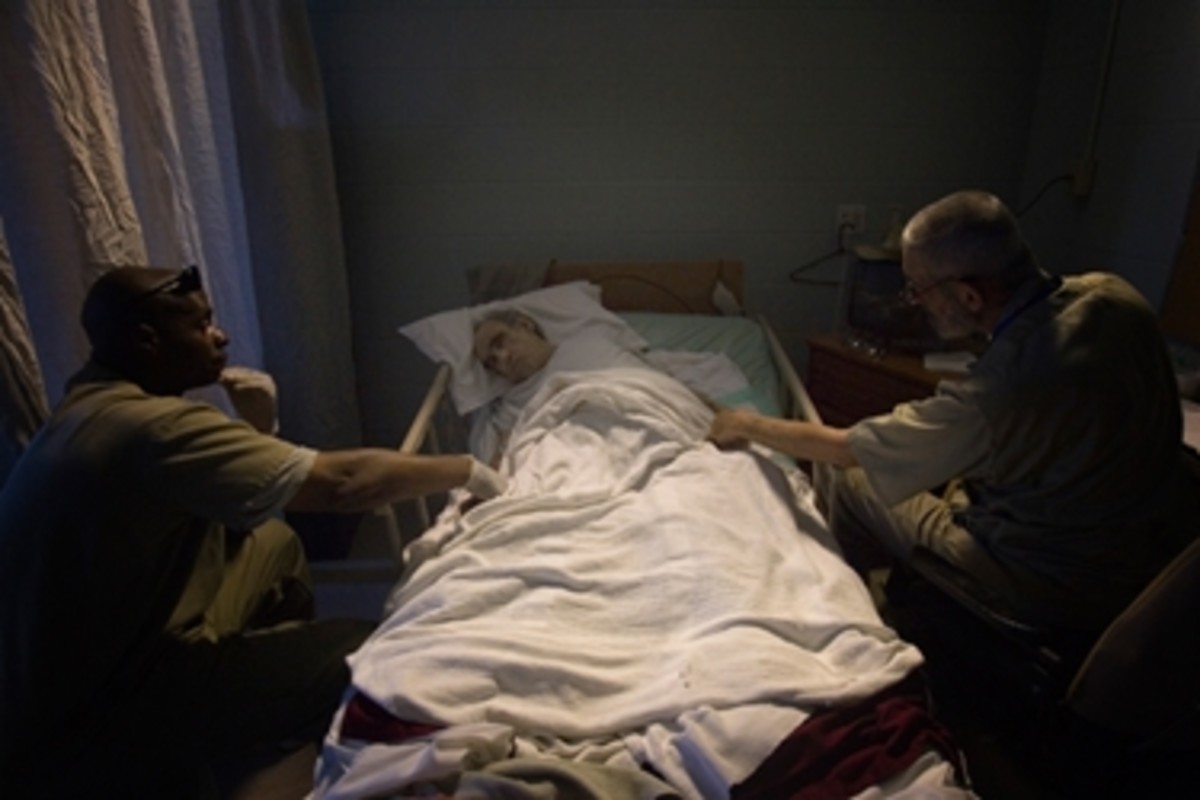 |
| Jack Hall and inmate volunteers at bedside |
I suggest you read the prison terminal press kit to learn more about how the documentary was made and more details on the people shown in the movie.
you can learn more recent news by following the social media sites for prison terminal:
Wednesday, April 30, 2014
Sunday, March 6, 2011
"Each year more than 3000 men and women die in U.S. prisons."
"It is estimated that 20% of the U.S. prison population will be elderly by 2025."
These are the sobering figures presented at the end of one of the trailers of Prison Terminal, a documentary about the prison hospice in the Iowa State Penitentiary, where inmates care for their own terminally ill. The film, directed and edited by Edgar Barens, spans a 6-month time period, and follows the lives of the patients, inmate volunteers, and staff. Here's one of the trailers (it starts after the first 15 seconds).
PRISON TERMINAL: THE LAST DAYS OF PRIVATE JACK HALL from Edgar Barens on Vimeo.
Prison Terminal is nearing completion, but needs some money to finish the project. Edgar started a fundraising campaign on Kickstarter March 1st, so if you want to see the full length film, consider a donation. By the way, the very cool thing about Kickstarter is that the money doesn't leave your pocket unless the project reaches its fundraising goal in the specified timeframe. So if, you want to be a part of seeing this project through, please do so by clicking here by Friday, April 15th.
This powerful story while being about the experience of dying and caring for the dying in prison, also makes me think of all kinds of important topics for our field and our country, like
- How we will cope with an ever-growing prison population, especially with increased health needs and costs of elderly inmates?
- Compassionate release is not the norm, but even if it becomes more frequent, how will inmates access health care after their release?
- How can we provide compassionate care to those who are dying in the prison system, or support the hospice initiatives that start on the inside?
- How can we help families have increased contact with the dying inmates?
- What are the special psychosocial, emotional, and spiritual needs of dying prisoners and their families?
- What is the best way to train the inmate volunteers, and what kind of bereavement care do they need afterwards?
Or something that I have struggled with in some of my palliative consultations for hospitalized inmates returning to prison...
- How should I change my prescribing practices to fit the correctional facility health care systems? (For example, no PRN doses of pain medications between certain hours at night because of lack of medical staff. Another example, no fentanyl patches allowed, because they could be removed and used by other inmates.)
 |
| Inmate Hospice Volunteers: Bertram Berkett, Michael Glover, Michael Williams, Charles Watkins (from www.PrisonTerminal.com) |
The Prison Terminal website has links to many interesting essays, and the National Prison Hospice Association has links on their site to articles which address a few of these questions.
One other interesting note, Edgar Barens has made two other films, the first, Angola Prison Hospice: Opening the Door, many Pallimed readers may be familiar with. The second, A Sentence of Their Own, is a documentary about a family impacted by one member's incarceration.
Usually a documentary is not just a story, it is an attempt to instigate cultural and societal change, something us hospice and palliative care types embrace wholeheartedly. So, in the spirit of providing compassionate, patient-centered care for everyone who suffers from serious illness, please visit the website, comment on this post, like or share the Vimeo videos, donate to get the movie finished (and maybe even get your own copy), and discuss it with your colleagues, family, and friends.
The more we spread the word about Hospice and Palliative Medicine, whether inside the walls of a prison or outside, through whatever platform we choose, whether it be social media, movies, radio, TV, print, or old-fashioned conversation, the more the public understands the value of what we do.
You can find Edgar and more on Prison Terminal at the website, Facebook and Twitter (@prisonterminal) and of course Kickstarter (where you can donate to the project).
(Edited: Updateed the video embed 12/21/2013)
Sunday, March 6, 2011
Wednesday, October 21, 2009
 The New York Times continues its coverage of hospice and palliative care related issues with a compelling report (with associated audio slideshow) on a volunteer hospice service at Coxsackie Correctional Facility in upstate New York. The article discusses the aging of the prison population, but mainly focuses on the experiences of inmates who have volunteered to provide support for dying inmates at the facility. Some of the lessons the inmate volunteers learn are not unique and might be extrapolated to all who provide care for the dying:
- Being in the presence of a dying person can be transformative. You likely will have moments that remind you how fragile life truly is and will learn to value it more than you did previously. Convicted murderer John Henson poignantly describes his personal version of this lesson.
“I was just thinking about why I’m in here and the person’s life that I took,” he said. “And sitting with this person for the first time and actually seeing death firsthand, being right there, my hand in his hand, watching him take his last breath, just caused me to say, ‘Wow, who the hell are you? Who were you to do this to somebody else?’”
- Attention to suffering at the end of life is a human right that everyone deserves and empathy is a key component. Benny Lee is another inmate who describes his attitude toward the death of even friends as "callous" before his hospice volunteer experience. Now, through his experience he's been able to see the suffering that death can entail and seems to have a growing understanding of the salutary experience of empathy.
- Premature reassurance of dying patients is non-beneficial (and usually, the reassurance is a response to the reassurer's emotions rather than the patient's). Wensley Roberts is yet another inmate volunteer who tells Allen Jacobs to "man up" as Jacobs faces death. Jacobs rebukes Roberts emotionally, asking Roberts if he wants to die in prison. When Roberts answers "no," Jacobs anger evolves into sadness as he states the nearly universal fear amongst prisoners of dying in prison.
The director of nursing, Kathleen Allan, also is indirectly quoted as saying:
...the inmate volunteers bond with the patients in a way that staff members cannot, taking on “the touchy-feely thing” that may be inappropriate between inmates and prison workers.I could see the potential for "bonding" between inmates that may not be possible with prison staff, but am I being Pollyannish to expect that there might be room for some display of empathy (that "touchy feely thing") by prison staff, especially the medical staff? If the inmate is fighting you to get out of his handcuffs or verbally abusing you, that's one thing, but if he's laying in bed in tears because he can't see his long-lost daughter and he's expressing remorse for his crime, doesn't that call for a different response? Empathy does not cross the line in this case, but a person needs to know how to express it, and it will come to no surprise to any that I have no idea what role empathy is given in the day-to-day jobs of prison guards. Empathy can play a role in conflict deescalation, so would seem to be a vital skill for a guard to employ.
At one time, Coxsackie did have an outside hospice agency that provided care for inmates. Eventually, they switched to the inmate volunteer program, ditching the agency. One might mistakenly conclude from the article that the hospice agency merely provided the same services as the inmate volunteer program (only with non-prisoners), and the article implies that the change was only for the better AND it might have saved money. In not having an expert interdisciplinary team (hospice nurses, social workers, chaplains, their own volunteers, medical director oversight, etc) managing the patient something was lost, no matter how impressive the benefits of the inmate volunteer program have been.
Lastly, Allan does talk about some very real problems that are faced in caring for dying prisoners, including drug diversion (with some inmate volunteers involved) and victimization of the dying. You don't have to be a prisoner to be at risk for these issues, though.
To read more about prison hospices, see The National Prison Hospice Association website. Also, see a couple of past posts related to the prison population here and here.
Wednesday, October 21, 2009
Sunday, March 2, 2014
 I’m know I’m not alone in pining for in-depth portrayals in mainstream culture of the complexities in caring for people near the end of their lives. Working in palliative care and hospice allows us to witness (and sometimes be part of) wonderful stories of love, forgiveness and redemption. Stories that would seem to fit in any high quality film or TV show come naturally in our field. So tonight when the Academy Awards are being handed out, keep an ear out for Prison Terminal: The Last Days of Private Jack Hall. It may only be mentioned right before a commercial break, or not at all on the telecast, but it is something any hospice advocate should know about.
Sunday, March 2, 2014
Saturday, August 23, 2008
 Multiple news organizations have recently highlighted the release of aging and terminally ill prisoners back into the community. Of course if you have very sick and possibly dying people coming into your community one of the services they may need is hospice. While in the prison system, the health care is paid for by the government, but once they leave the prison, they have to find their own coverage most likely through Medicare (if eligible), but of course there is a very good chance they may not ever get any coverage. The main focus of the news articles is the ballooning cost of health care for prisoners.
Many hospice agencies are likely to get at least a few referrals from recently released prisoners, which brings up many logistical issues about safety, potential charitable coverage for their care, addiction or diversion concerns, and possible complex family dynamics with the reintroduction of the person back into the family. These issues can come up in any hospice admission of course, but this unique situation may take some detailed care planning on the part of the hospice team.
Interestingly, few of the articles highlighted the role of prison hospice, which was featured in a excellent JAMA article last year. The focus on medical release for terminally ill patients was relegated to two paragraphs at the end of the article. The article cited a stat on average 8 of 18 annual requests are granted for release secondary to a terminal illness.
For our field, it can pose a major dilemma. Do we advocate for the well-being of our patient to possibly return home despite being a criminal who has not completed their given sentence? How do we compare our duty to the patient versus the societal justice and completion of the punishment accorded the prisoner? Should it matter what the offense is for?
Reference:
Linder, J.F., Meyers, F.J. (2007). Palliative Care for Prison Inmates: "Don't Let Me Die in Prison". JAMA: The Journal of the American Medical Association, 298(8), 894-901. DOI: 10.1001/jama.298.8.894 (free access with JAMA registration)
Saturday, August 23, 2008
Wednesday, October 19, 2011
The NPR show Tell Me More has a week long series on issues surrounding aging and end of life.
Today, the show highlighted the documentary Serving Life about care provided to inmates at Angola Penitentiary in Louisiana. The documentary aired this summer on the Oprah Winfrey Network.
Also, see this recent perspective piece from Annals of Internal Medicine which addresses the issue of compassionate release of prisoners near the end of life.
Pallimed has featured stories on palliative care in prisons previously (see search results for "prison" here).
Wednesday, October 19, 2011
Monday, September 3, 2007
Happy Labor Day.
1)
Supportive Care in Cancer has an article about the natural history of hypercalcemia of malignancy in the age of bisphosphonates. The patients were 260 consecutive patients presenting to a cancer center in France with solid tumors, no prior history of hypercalemia, and who received bisphosphonate therapy. Median corrected calcium levels were 2.83 mmol/L (~11.32 mg/dL) and half the patients had either head & neck or breast cancer. Median survival was 60 days across the cohort. The authors looked at patient characteristics associated with worse prognosis and the following ones survived multivariate analysis: corrected calcium over 2.83, hypoalbuminemia (<3.5 g/dL), squamous-cell histology, bone mets, and liver mets. Of note, women lived twice as long as men (94 vs 45 days), and one wonders if this was due to a preponderance of breast cancer in these patients, although this sex difference didn't survive multivariate analysis and survival based on underlying prognosis was not broken out.
This is an interesting article for a couple of reasons. Various sources have quoted for years that prognosis in the setting of hypercalemia of malignancy is dismal, but the last time I did a literature review on this it seemed that most of the studies (and there are only a few) were old (1980's, early 1990's), had relatively small N's, and were done prior to the use of bisphosphonates. So this recent data (which is, to be sure, from a single institution, although it does have a decent N for this type of study) is an important addition and, unfortunately, demonstrates that prognosis remains dismal for these patients, despite the availability of bisphosphonates.
2) JAMA continues their 'perspectives on care at the close of life' series with one on palliative care for prison inmates. It's a general overview, and well written. This is a topic I really have known nothing about and found it quite interesting. There are many differences in care between the civilian and prison worlds although, as the following he said/she said suggests, some things are exactly the same:
"DR V: Mr L gets MS Contin, I believe 90 mg every 8 hours. He can have Vicodin at pill call for breakthrough pain. . . . When I ask him about pain, he says it's fine. I have no reason to doubt him.
MR L: [The pain] gets pretty out of hand sometimes. . . . If you can catch the right nurse or the right doctor, they can situate you where they can help you some. If you were to gauge my pain on a scale of 1 to 10 right now, it would be about 8.5. I’ve learned to deal with that kind of pain. I don't want to be totally out of pain because then I won't know what I'm really going through."
Monday, September 3, 2007
Wednesday, December 13, 2017

I’m a little bored of all the discussion about physician-assisted suicide. Mostly it’s because legalizing PAS is going to have zero impact on nearly all of my patients, and I think the significant amount of press and energy it gets is a distraction from other things which actually would improve the lives (and deaths) of the patients and families I care for as a palliative doc.
The last time I blogged about PAS was part of my euphemisms series last year, when I elaborated why I did not like terms like ‘assisted death’ or ‘aid-in-dying’ and prefer ‘assisted suicide’ and ‘euthanasia’ (or ‘voluntary active euthanasia’ to be super-clear) instead. I appreciate that I am on the losing side of history here, people already are and are going to increasingly call PAS some variation of physician/medical - assisted/aid-in - death/dying but I’m still sticking with PAS for now. I’ll also note that the Canadians essentially proved my complaint correct last year, in that their Medical Assistance in Dying (MAID) law includes both PAS and euthanasia, underlining my point that the ‘assisted death’ locutions are imprecise and potentially confusing, and that 'PAiD' is no simple replacement for the much clearer 'PAS'.
In the comments on my post last year someone intimated I must not support legalization of PAD and that’s why I want to stick with the label “PAS.” Well, I don’t like PAD or PAS, but it’s also fair to say I have a variety of thoughts and emotions about PAS and its legalization that aren’t easy to neatly summarize. I’ve always felt uncomfortable with it, but I also never thought to myself Dr Tim Quill should lose his medical license or be in prison. In fact the only thought about it I have which is clear and unambiguous is my leading thesis above, that the attention paid to it completely outsizes its clinical relevance to the vast majority of our patients with serious illness, which approaches zero.
I’m thinking about all this because a recent Annals of Internal Medicine has the American College of Physician’s revised position paper on the ethics and legalization of PAS, along with several editorials, and a nice summary of 20 years of Oregon’s Death With Dignity Act (DWDA) data (Table of Contents here). If you care about end-of-life issues or the debate around PAS, get informed and read this issue - it’s good.
The ACP paper is a well-written, cogent discussion of why the ACP opposes legalization of assisted suicide, and does a far better job than I could of outlining the arguments against it. I agree with a lot of the arguments: patients seek PAS not to actually relieve physical suffering but instead for existential reasons; it is unwise to medicalize existential suffering especially with the drastic and irreversible means of lethal ingestion, and legalizing PAS can undermine the doctor-patient relationship.
However….
The reality is that PAS legalization is unfolding in the US as a human rights/civil rights issue, not really a medical issue, and honestly what us doctors think about it doesn’t seem to matter much.
Large-scale organized medicine in the US (eg the AMA, ACP, etc) is solidly against legalized PAS. (Perhaps this is changing – the California Medical Association changed its position to neutrality prior to the its legalization in CA.) Most palliative clinicians (I think) are against it (obviously there is an important minority in our community who are very much for PAS legalization). (I've not seen good data on this in the US, but I believe it to be true; in the UK when it was polled many years back, palliative docs were the group of docs most opposed to legalization.) But the voters and legislative bodies who are legalizing PAS are not persuaded by our objections. The broad, tangled, clinical/therapeutic, and professional concerns many of us have about it aren’t a persuasive concern, because PAS is seen more through the lens of an individual civil right, and not as a medical issue.
Frankly, PAS remains pretty popular with the public (although I wonder if the public actually understand what it is and isn’t), and I think in the US the wave of legalization is going to continue state by state in the coming decades, and organized medicine is not going to stop this because we’ve already lost the argument to the realm of ‘rights.’ Rights are important, of course (!), but I really want to emphasize this point because I think that when people like me think about PAS we think about our suffering patients and our aspirations to help them find meaning and comfort in their dying days, and all those clinical, therapeutic things we do in hospice/palliative care and medicine to care for patients nearing their deaths, and none of that matters much in the legal debate because the focus is on a person’s right to autonomy and control.
So I’ve been trying to accept and anticipate that this is going to happen, and asking myself how I am going to react to it, and also trying to understand PAS with actual data about actual patients (as opposed to grand pronouncements and philosophical noodling), which thankfully we have, because the Oregon PAS experiment has been highly investigated.
Looking at the data (in the Oregon DWDA paper above and other publications) I have several major observations.
1) The proponents of PAS who claim it is an important option to prevent physical suffering at life’s end should kindly stop making such claims. The data over the year has clearly supported the observation that most patients seek PAS for what I think are best characterized as existential reasons: concerns for loss of autonomy and function, etc. Patients who would (quite literally) rather die than go through the dying process which indeed strips one of autonomy and function. PAS is not, on the ground, actually being used to mitigate unrelenting physical suffering in any major fashion. The proponents of PAS should defend it and promote it for what it actually is, and not use scare language to suggest to people they need this option to make sure they don’t needlessly suffer as they die.
2) The opponents of PAS who claim that it will lead to a slippery slope (it will be used by doctors or families to force poor, disabled, or otherwise vulnerable people into killing themselves) need to stop making that claim, at least without the qualification that that has not happened in Oregon. I.e., we have nearly 20 years of data showing that a well-designed and implemented PAS program can exist without any appreciable slippery slope. I’m not saying that there couldn’t ever be a slippery slope, just that we now have lots of data showing that it is not inevitable. All human institutions and programs like are open to abuse and misuse – the Oregon PAS program and medicine as a whole in fact relies on good faith participation which can be abused. But it hasn’t, at least in any sort of measurable, systematic way. In fact, the people who participated in PAS in Oregon are overwhelmingly insured, white, well-educated, and dying of things like cancer, ALS, and organ failure (not, eg, quadriplegia). (Oregon is a very white state, but still the patients receiving PAS are disproportionately white, but one is curious as to what the data will show in California in the coming years.)
3) I do myself have deep concerns that PAS will undermine the profession, as it transforms doctors from healers to, well, something else. However, I have had to face the reality that this has not apparently happened. I don’t have any data for this one, but I know doctors in Oregon, and I’d have a hard time making any sort of claim to the idea that 20 years of PAS in Oregon has hurt the profession, or health care as a whole there. I still think it could hurt the profession, but like in the slippery slope discussion above, I have to admit that it in reality has not, at least in Oregon, and be honest with myself that my objection was probably my own dislike of PAS and bull-headed professional desire to help dying patients find meaning and solace, even in death. When you're getting emotional at the bedside, you always want to ask yourself "Is this my shit?" and if it is you try to check it. The same, perhaps, with emotional policy decisions. I really recommend reading this reflection piece in JAMA Internal Medicine written by two Canadian doctors helping a patient die under the new Canadian MAID law in which they describe reluctantly participating in the death of one of their patients. It's a thoughtfully written piece, among other things one senses that this 'assisted death' was in fact full of meaning and connection. Additionally, I have a hard time reading the piece and concluding that these doctors' actions are going to destroy our profession. I know I feel a patient wanting aid-in-dying as a sort of professional failure, but reading this reflection has forced to me acknowledge that I may need to just get over myself there.
4) Finally, the Oregon data continue to show that PAS is incredibly rare. About 0.19% of all deaths in Oregon are with PAS, and while it’s impossible to clearly define what the denominator should be, by one measure PAS accounts for 0.54% of potentially eligible deaths. Over ~20 years in Oregon the number of PAS deaths has risen with population growth but is not growing and growing. Some additional patients get lethal prescriptions and never use it. Literally, PAS is an end of life option for the 1%.
Which is exactly my point.
Mass legalization of PAS is not going to be a catastrophe, but it’s also going to do approximately nothing for literally 99% of our patients at the ends of their lives. And this is why I’m a little bored with the whole thing. I’m not oblivious to the fact that PAS has cultural significance (presumably both positive and negative) beyond its actual impact on end of life care, but the idea you come across all the time both implicitly and explicitly that PAS is an important option to have, I just don’t buy. I’m not saying citizens should be denied this option, and undoubtedly access to PAS is very important to the few patients who choose it, it's just that it seems like a big distraction from far more important work that needs to happen.
Because, there are some actually, really, truly, important things that could happen in this country which would immediately, measurably, improve the lives and deaths and our patients with serious or terminal illnesses.
It’s a cold, grey December afternoon in Minnesota as I write this, but off the top of my head, here are a handful of things that would actually, really, truly improve our patients’ and families’ lives with serious or terminal illnesses:
- Universal, affordable health insurance, including drug coverage.
- Universal paid sick leave, including paid family care leave so someone can take 4 months off to care for their dying sister at home without losing their job, their health insurance, and their mortgage.
- Earlier and more routine access to palliative specialist teams (and depending where you live psychiatrists, geriatricians, and addiction medicine programs).
- Widely available, home-based palliative/advanced illness management programs which include nurses, doctors, social workers, aides, chaplains, therapists which can provide active disease management at home, alongside palliative symptom management, goals of care planning, and emotional, existential, and grief support.
- Better, universal primary palliative care training such that primary care providers and key specialists have adequate skills in having goals of care / serious illness conversations.
- A hospice benefit which didn’t make many of our patients choose between hospice and many commonly used palliative treatments like chemotherapy, blood products, noninvasive ventilation, etc.
- A hospice benefit which paid for room and board at a facility.
- Drug innovation, especially for analgesics which are safer and better tolerated.
Drew Rosielle, MD is a palliative care physician at University of Minnesota Health in Minnesota. He founded Pallimed in 2005. You can occasionally find him on Twitter at @drosielle. For more Pallimed posts by Drew click here.
Photo Credit: Boredom score by Flickr user smartfat, under Creative Commons Attribution-NonCommercial 2.0 Generic (CC BY-NC 2.0)
Wednesday, December 13, 2017
Thursday, May 24, 2007
Kevin MD has been keeping the blogosphere up to date on the sudden loss of two anonymous physician bloggers, Flea (archived blog) and Fat Doctor. For those of you not following all of this, basically the medical blogging community comes in two flavors, anonymous and not.
The anonymous bloggers have the ability to demonstrate some of the inner frustrations and joys of being a health care professional, and these have been some of the most well read blogs. Flea, a pediatrician, was one of the most popular medical blogs of 2006. The personal stories and good writing made for entertaining and interesting reads. Most early medical blogs started as anonymous and the most visited medical blogs are usually by anonymous people. But the personal stories about interactions with patients started to get some people suspicious of HIPAA and patient's rights, and Flea, in the middle of a malpractice suit, was blogging a lot of what was happening with some of the identifying details removed.
Drew and I have decided to go the non-anonymous route to ensure credibility and responsibility in our open discussions. Now of course as you know that means we still can touch on sensitive and taboo subjects, especially given that death in general is taboo. But hopefully by having our identities known we can establish trust, and maintain a site that will be helpful for years to come.
I know this does not have a lot to do with hospice and palliative care, but it kind of affects Pallimed, so I thought you should all get a chance for some insight into our little piece of the world here.
With all that being said, our good anonymous friend, HospiceGuy has a post about a hospice article from MGH. And a few other news tidbits:
Kevorkian is likely to be let out of jail on June 1st after serving 8 of his 25 years in a Michigan prison. So get ready for a few news items to pop up and for family, friends, patients, and co-workers to ask your opinion on the whole Kevorkian/euthanasia issue. You heard it hear first!
And philosophy students get "Epi-curious" about why one should not fear death. What do you think some of your patients might say if they read this post?
The makers of Worlds of Warcraft, the engrossing online game, gave a 10-year old boy with metastatic cancer his 'Make-A-Wish', by allowing him to create a character in the online world. They also let him make his dog into a charcter, pictured below. That is pretty cool. (Thanks to Kevin MD for the link.)
(First Photo courtesy of flickr.com user june c oka)
(Second Photo courtesy of Blizzard via ocregister.com)

Thursday, May 24, 2007
Tuesday, January 13, 2015

Looking back on 2014, it seemed like hospice and palliative care issues were constantly in the news. But then again, I may be standing in the single loudest position in the echo chamber of palliative care. Even with the awareness of that bias, it is clear to me that we had many significant events this year in our field that will really influence where we go in 2015 and beyond. (Although if you look at the graph below hospice and palliative care are steady to declining in percentage of search on Google.)
We have never done a formal year in review here at Pallimed, and now that we are finally doing one, I’m sorry that I don’t have the past years to reflect back upon. Big shout out to Kathy Brandt for also doing a year-end review on her fantastic site the kb group (if you have not yet subscribed, you should.) She brought up a few ideas I had not had considered myself. CAPC also published a year in review worth a look. In addition, last week at #hpm chat, Dr. Meredith MacMartin hosted on just this topic. There was a lot of great discussion and some new topics were brought up that I was not aware of.
So what were the big events of 2014 for hospice and palliative care? (in no particular order and with categories I just made up)
And if you want to have a bit of fun with us, please join us in a poll to pick the top news stories of the year for hospice and palliative care.
In the media spotlight
Brittany Maynard and the national conversation about the right to physician assisted death
Atul Gawande hitting the New York Times Bestseller list with “Being Mortal”
Anonymous $10M gift to Dartmouth Hitchcock Center for Hospice and Palliative Care
ResolutionCare raises over $130k through crowdfunding for palliative care services
AAHPM completes it’s first ever fundraising campaign, Shaping the Future raising over $1M
Cambia Health Foundation announces first class of Sojourns Scholars ($180k over 2 years)
Medicare Part D requirements impacting how hospice organizations cover medications
AAHPM and HPNA join forces on Measuring What Matters
Aspire Health and former Sen Bill Frist debut new palliative care model in 12 markets
NPCRC expands services with both consultancy and grant review support
JAMA Hospice article reinforces hospice benefit in late stage cancer
Lancet article highlighting outpatient palliative care improves quality of life and patient satisfaction
Home palliative care improves symptoms and increases odds of dying at home published in JAMA
Organizational impact
AAHPM announces 40 under 40 - highlighting leaders for the next wave of palliative care
HPNA, HPNF and HPCC launch the $5M Advancing Expert Care campaign
NHPCO launches Moments of Life campaign
World Health Assembly resolution on palliative care
40th anniversary of hospice care in the United States
FHSSA expands and rebrands as Global Partners in Care
Global Atlas of Palliative Care at the End of Life published by WHO and WPCA
NIH and NINR launch pediatric focused campaign, Palliative Care: Conversations Matter
Don't forget to take the poll!
Christian Sinclair is an palliative care physician at the University of Kansas Medical Center and editor of Pallimed. When he is not advocating for palliative care on social media (@ctsinclair), you can probably find him playing board games.
Tuesday, January 13, 2015
Wednesday, June 20, 2007
1)
Anesthesia and Analgesia has an article urging medicine to conceptualize pain relief as a fundamental human right, and several editorials in response (one on improving access to analgesics worldwide; one on legal aspects of pain management; a general supporting editorial ; and a cautionary editorial warning of overuse of opioids to control chronic and postoperative pain). The main article is a comprehensive review at how and why pain is undertreated and the health and societal costs of this, and focuses a lot on international (WHO, etc.) efforts to improve pain relief. One sobering tidbit: 6 nations use 79% of the world's supply of morphine and 120 countries use virtually zero. (One assumes that in most of these countries the strong opioid of choice is nothing, and not Actiq or OxyContin.) The most interesting aspect of the article was its relatively lengthy summary of legislative and judicial efforts in 'developed' countries to define pain relief as a right, a medical standard, and inadequate pain relief grounds for civil liability.
While the position that pain relief is good/important is rather uncontroversial, the counter editorial reveals that decades into the pain control movement the issue remains very polarized, and polarized specifically around the use of opioids. One side is the opioids are safe and effective and the best we've got camp, the other is the opioids aren't safe, aren't effective, and not worth it camp, and in between the great mass of medical professionals remain afraid to treat pain, and ignorant of how to do it even if they wanted to. It's like a yelling match between one group saying WE ARE NOT TREATING PAIN DOCTORS ARE OPIOPHOBIC PATIENTS ARE SUFFERING and the other WE ARE OVERTREATING PAIN OPIOIDS KILL WE ARE CREATING ADDICTS. And like I've blogged before there's a sense out there that there's a backlash growing against opioids for chronic non-malignant pain and this editorial quite effectively spells out the issues at hand. They note, and I can't argue with them, that there are a lack of quality, long term data supporting the safety and efficacy of opioids for chronic non-malignant pain (however see this post for how research findings can be twisted). While true, there is evidence that a substantial minority of people really benefit, although (and this is my grand gloss on the entire field) - across a population of patients with chronic non-malignant pain a majority of them won't benefit from long-term opioids (and in many studies people just stop using them after a while because the toxicity seems to outweigh the benefit they're getting). Taking this as true it seems like the reasonable public policy should be to, in fact, through clinician education and training, make sure physicians know how to treat pain and effectively use opioids, and, per the 'pro-opioid' camp, make sure the regulatory environment is such that physicians who prescribe opioids for legitimate purposes don't have to worry about 30 year prison terms.
2)
Along these lines Annals of Internal Medicine has a short piece about strategies to stop abuse of prescription opioids . It reviews some of the evidence but is mostly based on interviews with experts. A worthwhile, quick read.
3)
The May Harper's, in the Readings section, had an amazing excerpt from remarks from the undertaker Thomas Lynch made to the President's Council on Bioethics about the treatment of cadavers (these were from hearings about organ transplantation). (Looks like the full transcript of his remarks is here...scroll down a little). Read this.
Some choicer quotes (sorry about the length of this but it's in the public domain, & he does ramble a little, and I can't help myself):
"And there is a difference, as one of your panel pointed out, between the notion of medical death, metabolic death and the notion of social death and spiritual death and actual death as far as your family is concerned, and those are the things this council must wrestle with when you seek to set forth useful policy. I might know, for example, that at the end of a process with cremation, we end up with say 14 pounds of bone fragment and dessicated tissue that we can put in a box and hand to the family. But when you see the elderly sister come to claim the ashes of a sister whose own children couldn't come and get her, when she bears that box like Viaticum, when she walks out the door, flips the button to open the trunk and then reconsiders and goes to the back door and opens it up and then thinks better of it and closes it again, when she goes to the passenger — front seat passenger door, opens it up, places the box on the front seat and then clicks a seatbelt around it, you can see that whether we are remnant or icon or relic is not up to you or me. It's up to the living that bear us in their memory and in fact, that bear our mortality because we are mortals, we are humans. We are tied to this humus, this layer of earth from which our monuments and our homes and our histories rise out of."
"Right between the inhale and exhale of the bone-wracking sob such hurts produce, some frightened and well-meaning ignoramus is bound to give out with, "It's okay, it's not her. That's just a shell." I once saw an Episcopalian deacon nearly decked by the swift slap of a mother of a teenager dead of leukemia to whom he had tendered this counsel. "I'll tell you when it's just a shell," the woman said. "For now and until I tell you otherwise, she's my daughter." The woman was asserting the longstanding right of the living to declare the dead, dead. Just as we declare the living alive through baptisms and lovers in love by nuptials, funerals are the way we close the gap between the death that happens and the death that matters. It's how we assign meaning to our little remarkable histories. And the rituals we devise to conduct the living and the beloved and the dead from one status to another have less to do with performance than they do with meaning."
Wednesday, June 20, 2007
Saturday, June 16, 2007

This week's New York Times Sunday Magazine cover story is on criminal prosecutions of pain doctors for prescribing opioids. It is a long article which mostly focuses on a single case of a physician who certainly recklessly prescribed opioids for chronic pain - but for whom there's no evidence that he did it with any sort of intent other than to relieve pain (he wasn't running a prescription mill, conspiring to divert or otherwise distribute opioids, nor was he profiting from people misusing his prescriptions). The journalist more or less accuses the DEA/the Feds of reassuring physicians they won't be prosecuted unless they prescribe with criminal intent - knowingly prescribing opioids to be diverted or abused etc. (and not just recklessly but with analgesic intent which would be a matter for civil litigation/malpractice/etc.); then refusing to define what proper medical prescribing is (because, after all, the DEA shouldn't be telling docs how to practice medicine); then going ahead and prosecuting docs anyway for prescribing recklessly but with analgesic intent.
"But the agency is defining issues of medical practice in dramatic fashion — by jailing doctors who step over the line. It would not seem to be bothering, however, to draw the line first."
"Proper pain management will always take time, but the D.E.A. can at least ensure that honest doctors need not fear prison. It should use the standard it claims to follow: for a criminal prosecution to occur, a doctor must have broken the link between the opioid and the medical condition. If the evidence is of recklessness alone, then it should be a case for a state medical board, the D.E.A.’s registration examiners or a civil malpractice jury."
The article closes with the story of one of the imprisoned pain doc's patients who had been on gram doses of oxycodone daily, apparently doing really well - working, etc. - whose life was dramatically worsened when the doc was arrested and he couldn't find anyone to prescribe him analgesic doses anymore...
'With Ben’s permission I talked to his current doctor, who said Ben was a good patient but had been taking way too much. “I thought Ben made an error,” he said. “He had been taking five or six times the recommended dosage. There are well-recognized levels, and you don’t step across the line. You may have to live with some pain.”'
Recommended dosage? Well-recognized levels? The line? No wonder physicians are being imprisoned if their colleagues (and therefore DA's, judges, and juries) believe this.... While I'm sure our chronic pain colleagues are worried I also wonder if this trend continues if there will be spill-over into the cancer pain world.
Saturday, June 16, 2007
