

Saturday, February 4, 2006
 E-published by BMJ this week is an article (full text pdf) discussing the attitudes of 28 inpatients with advanced, incurable cancer admitted for spinal cord compression treatment or symptom control treatment. The authors used qualitative analysis and semi-structured interviews to see if patients felt any benefit from receiving low molecular weight heparin (LWMH) for DVT prophylaxis. All patients were ECOG 4 and most had good insight into the incurable nature of their cancer. They were all already on LMWH when interviewed and they all knew death could result from a DVT->PE. Most explained they could not see why they should not have it and saw it as just a routine part of their care. A few of my favorite quotes from a patient is this one (it helps to say with a British accent):
"...there’s nothing to it, you don’t feel it, and you’ve got to have ‘nasties’ to have ‘nices’ haven’t you?”
"I’d like to do a few things before I pop my clogs. I’ve got enough to worry about without having to worry about deep vein thrombosis.”
'Pop my clogs'...I gotta remember that one.
Most also expressed disgust at compression stockings, and would rather have the injections. I am glad the authors did this study as it does rock the boat of common wisdom in the palliative care community, namely one of always decreasing medication burden and limiting costs. Burden is a personal perception and some patients do see positives in continuing their statins, coumadin and LMWH. They did not extrapolate that every bed bound palliative/hospice patient at home should have LMWH, which would seem like a natural extension of the logic that all patients (not just inpatients) with advanced cancer have thromboembolism.
The major take home point I gleaned from this article is that (as always) it does not pay to assume what the patient sees as a burden, but rather to ask them for their insight.
Saturday, February 4, 2006
Since we live in a death denying culture, I always enjoy seeing mainstream discussion/depiction of the dying process and the importance it has in all of our lives. (Terminator movies notwithstanding) From the 'Stargazing' column on the front page of the entertainment section in my local Kansas City Star paper come these excellent insights about death from actress Emma Thompson. These comments stem from dealing with death in her new movie "Nanny McPhee" (No we don't do movie reviews here at Pallimed.)
"Children understand much better than we do that life and death existtogether simultaneously. As we grow older and try to make sense of it all...our tectonic plates start to ossify and nothing shifts anymore. But children are always moving. They understand that sometimes death comes, and it can be like that. They're not angry about death. They're angry about no communication, no time and no listening to the really sensible things." (emphasis mine)
- Emma Thompson

I thought she was spot on and spoke to this topic very well. I wonder if it was from a personal experience. These words sound like they come from our Child/Teen Specialist at work.
AAHPM
I will be there Friday and Saturday at the conference as well and I am very excited about hosting the Fellows' Case Conference for the second year in a row. We have some really good cases, so hopefully some of you will be there. Say hello to Drew and I and help us get the word out about Pallimed. And I will not be at Ruths' Chris Steakhouse Friday night. I will be at the Grand Ole Opry!
Three things:
1.
I happened upon a short, interesting review of the death rattle in Neurocritical Care from 2005. It focuses on the incidence and treatment of the death rattle in the ICU, as well as managing family distress regarding it. My response, somewhat counter to the focus of this hyoscine-for-everything-review, is that pre-education of family members prior to terminal extubations in the ICU is mandatory--focusing especially on warning them that abnormal breathing is to be expected and is not necessarily a sign of suffering.
2.
Lancet Oncology has published a nice review on the oral complications of radiotherapy. It covers the pathogenesis, prevention, and treatment of mucositis, xerostomia, osteoradionecrosis, and trismus. Like many articles in LO it seems quite enamored with basic science and less interested in practical, clinical information, but oh well. It does have some very nice photos and would make a good addition to one's teaching file.
3.
I'm going to be at the AAHPM conference in Nashville most of next week and imagine I won't be blogging much if at all. I am participating in the Fellows' Case Conference Friday afternoon (4:30-6pm; session #423). I will be discussing the management of hospice patients who have ongoing substance abuse problems. It will rock your world. Seriously though--there are some fantastic sounding sessions occurring concurrently, that will probably rock your world more, but what can I do? Come up and say Hi if you want. I have a sneaking suspicion Christian will be there too, if he's not too busy cavorting with drug reps.
Tuesday, January 31, 2006
The current Journal of Clinical Oncology has a couple articles to note.
First, there is a discussion of recommendations for breaking bad news. It is based on data that is being gathered for a larger trial about communication in oncology clinics, and uses information coded from video-taped encounters between oncologists and patients. The authors present their discussion against a straw-man of pre-existing 'guidelines' about breaking bad news which they suggest are overly simplistic. Obviously they are overly simplistic--that's the nature of guidelines--but the authors' observations about how bad news unfolds in the clinical encounter are nonetheless interesting and useful. First, they observe that 'bad news'--defined as " [news that] results in a cognitive, behavioral, or emotional deficit in the person receiving the news that persists for some time after the news is received"--comes out all the time in routine clinical encounters (not just in the You Have Cancer or You Are Dying talks). Second, they point out that to patients and families there's sometimes not a central Bit of Bad News, but rather several (3.2 on average per encounter, actually!) pieces of 'bad' information that come out in an encounter. Finally, they observed that a physician-patient dyad doesn't really exist, and that family members often contribute as much to the encounter as patients or docs. None of this is earth-shattering; but it's interesting to see data taken from actual physician-patient-family interactions. I'm not clear what the goal of the larger trial is, but based on this preliminary missive, it seems that its results may be quite interesting. I guess we'll wait and see.
Additionally, a randomized-controlled trial about a multidisciplinary intervention to improve the quality of life for 'advanced' cancer patients is presented. This was a trial at Mayo for patients with advanced cancer (defined as life expectancy longer than 6 months but mortality at 5 years thought to be over 50%) undergoing radiation therapy. The treatment group received a multidisciplinary intervention (8 sessions, 90 minutes each, over 3 weeks) comprising physical therapy, chaplaincy services, and broad ranging cognitive-behavioral-emotional education and support. Essentially, the intervention group did a little better quality-of-life-wise at 4 weeks but this quickly petered out; mostly this benefit was in stopping the decline in quality of life during radiation treatment that the control group experienced. See the figure below...despite statistical significance not a very impressive response.
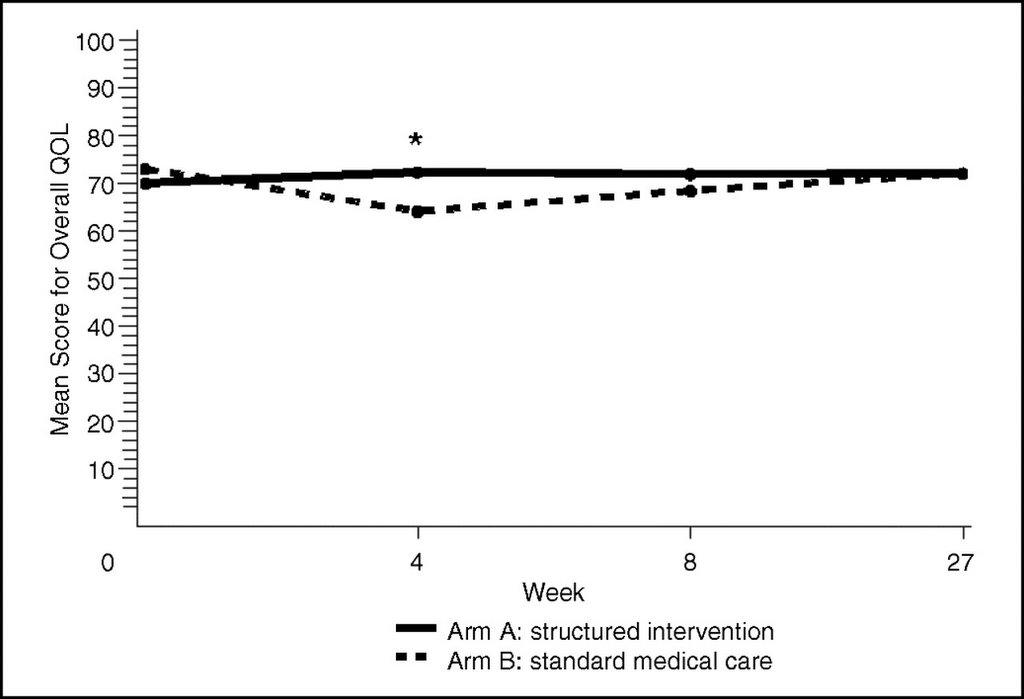
This is one of those articles that if you read the abstract you get the feeling that this was a solid success, whereupon reading the text you realize that it the intervention's benefit was modest (at best) and transient (and at what cost?). My gloss on this is that the problem may be one of selection--services like this are probably only helpful for a subset of patients and the trick may be in figuring out which ones. Part of what I'm suggesting is that for many patients 'quality of life' is adversely affected by so many things that these sorts of interventions just can't address. Having advanced cancer sucks (as many buttons worn by staff at the cancer center I work at attest to); it makes you feel crappy and usually eventually takes everything meaningful away from you including your life. Benefits aside--cancer treatment, radiation included, also sucks and makes you feel crappy while you're undergoing it. Will having sessions discussing body image and stair exercises make this suck any less? For many people clearly not; the trick is to identify those for whom it would help.
(& I did listen to the Fresh Air bit from earlier this week & it's quite good: a short, fluent, and sometimes personal account of geriatric and end of life care in 21st century America.)
Tuesday, January 31, 2006
A quick basic science fix:
The Journal of Internal Medicine has a review on opioids in critical illness. Specifically, it is about the complicated hemodynamic, endocrine, and immunologic effects of endogenous and pharmacologic opioids on the response to critical illness (hemorrhage, sepsis, surgery, etc.). Ultra brief summary: rat studies suggest opioids attenuate the counter-regulatory response to critical illness in bad ways, so are we doing harm by using them in the ICU? There's no answer to this of course, but a plug for ketamine as a hypothetical counterbalance to this hypothetical danger is mentioned.
Also...
Gastrointestinal Endoscopy has published a review on feeding tubes in people with advanced illnesses. James Hallenbeck wrote an accompanying editorial & discusses it in his blog at Growth House.
According to my wife, during today's Fresh Air radio show on NPR about Medicare Part D with Dr. Christine Cassel from the American Board of Internal Medicine, they venture into discussing end of life care in the hospital (& the great need for improving it in the US). You can listen to the show on-line if you miss the broadcast.
Sunday, January 29, 2006
Some excerpts from 2 (two!) Fed Ex letters I received from Valeant Pharmaceuticals:
As a recognized leader in Palliative Care you have been specially selected to particpate in a Consultant Forum. The focus...is to understand the current perceptions towards Cannabinoids and their potential...
Now I thought that was nice that they complemented me. Made me feel good. A recognized leader. Not bad for being two years out of fellowship. Hmmm..the current perceptions towards Cannabinoids. More on that in a bit.
Consultant Forum particiapants will be provided a consulting honrarium of $500 from Valeant Pahrmaceuticals. ...will be held at Ruth's Chris Steak House in Nashville...in conjunction with the AAHPM 2006 Annual Assembly.
Wow! That is a lot of money. In fact very close to the amount for the whole assembly. 3 days of educational talks and I have to pay over $500, but then I could also receive $500 for helping advocate for cannabinoids in the United States.
Well since you already know my opinion on pharmaceutical industry and honorariums, (I don't like them and vow not to take any pens or 'free lunches.') you already know I was not going. I will be going to the Grand Ol' Opry that night on my own dime though!
So I did a little digging. Valeant Pharmaceuticals is based out of Costa Mesa, CA and is the maker of Cesamet (nabilone) an anti-emetic based on the cannabinoid class. My first letter was received in early January. Five days after the FDA denied Valeant changes in labeling.
What those changes were are not clear, but Valeant is not putting Cesamet on the market until further discussions with the FDA. Well Cesamet is on the market in Canada where it controls 88% market share. The drug was originally developed by Eli Lilly, but never went to market in the US when it was apparoved for Chemo induced nausea and vomiting in 1985.
So where am I going with all this?
Nabilone itself looks like it may be an effective antiemetic per this report in BMJ in 2001 (pdf) (no declared competing interests). I have no problem advocating for more effective medications for palliative care. My problem is the way this is done. I may end up advocating for this medicine, but I do not feel like I need to get paid $500 or get a nice steak dinner for it. Why not more discussion among oncologists if they feel they have no effective tools for chemo induced N/V? Why not more presentations at conferences that are open to scrutiny by peers and without funding from the pharma?
I want everyone to understand I have nothing personal against nabilone, cannabinoids or Valeant Pharmaceuticals or the FDA. I believe this is all part of the dance of the current system and it is unfortunate it has to be this way.
I know my question at the Assembly will be: Hey you going to Ruth's Chris on Friday night?
PS: Like the name: Cesamet (Cease + Emesis OR Cease + Mets)
Sunday, January 29, 2006
 For the Pallimed readers who are not board certified with the ABHPM, just a reminder that 2006 is the last year until 2008 to get certified before the American Board of Medical Specialties begins oversight.
The test dates are Nov 4-11 (one day only)
The fee is $1100 if you register by April 1, 2006. Last day to register is May 31, 2006.
See the ABHPM website for more details depending on your specific situation.
Saturday, January 28, 2006
Another e-publication ahead of print from Supportive Care in Cancer...
Our colleagues at the Cleveland Clinic have compared the systematic assessment of patient symptoms to relying on patient reporting of symptoms. They looked at 200 patients referred to their service (the vast majority had cancer; 44% were inpatients). The patients were initially asked two open ended questions about symptoms to see what they volunteered, and then underwent a directed, systematic assessment of 48 symptoms. This is a well done, important, and provocative study.
First off, this gives us a valuable look at symptom burden in a cohort of patients referred to a palliative care service, albeit at a single institution. The top 12 symptoms found, in descending order, were fatigue (73%), dry mouth (67%), pain (64%), anorexia (59%), weight loss (54%), early satiety (49%), insomnia (43%), dyspnea (43%), drowsiness (41%), constipation (39%), cough (39%), and depression (36%). Not surprisingly, the more severe or distressing the patient rated a symptom, the more likely s/he was to report it. However, and this is probably the most important finding of the study, several symptoms were rarely volunteered even if the patient rated them "distressing" when specifically asked about them. This included fatigue (42% volunteered this symptom), anorexia (31%), and early satiety, dry mouth, insomnia, and weight loss (all less than 10%). Likewise, several symptoms which the patients rated as "moderate" or "severe" (even if not "distressing") were rarely volunteered--these included fatigue, dyspnea, early satiety, drowsiness, dry mouth, insomnia, and weight loss.
Does this mean all patients should have directed, systematic, and exhaustive symptom assessments? I don't think so, but you could use these findings to argue with me. Probably very few of us when interviewing patients rely solely upon patient volunteered symptoms, and a good 'review of systems' is integral to every--at least initial--patient assessment. So whether systematic assessment actually offers the patient anything more than routine care is unknown. This assumes of course that routine care is good care, but that's another story. What would need to be demonstrated is that systematic assessment offers patients some benefit--quality of life, symptom improvement, satisfaction with care, etc. There's also the question of burden to the patient of exhaustive interviewing, not to mention the time-cost and practicality of this outside of the research setting. Also, what is one to make of symptoms that patients, when asked, say are distressing or severe, but that previously they didn't bother to offer. Some of these are probably symptoms that patients have resigned themselves to as inevitable, even if they aren't, and these are the ones that we could make an impact on with systematic assessment (or a thorough history taking!). One wonders though, despite being reported as 'distressing,' how many of these symptoms were making a substantial negative impact on the patients' quality of life in this study? Are these research-generated symptom incidentalomas? Nevertheless, clearly it's a good idea to be on the look-out for those under-reported symptoms mentioned above.
Saturday, January 28, 2006
Thursday, January 26, 2006
Supportive Care in Cancer has e-published a short article about using gabapentin for sweating in cancer patients. It presents a case-series of 9 patients with advanced cancer and severe sweating (which they rated on a 0-10 numeric rating scale); all of the patients had "idiopathic" sweating ( i.e. none had neuroendocrine tumors or were receiving hormonal therapies etc.). All patients had a good response to a week of gabapentin (at least a halving of their sweating rating) with tolerable side effects. Doses ranged from 600-1800mg a day. All these patients were inpatients on a cancer ward presumably receiving other treatments and so, along with simple regression-to-the-mean, more study is needed to say to least. But this is promising, and adds to the slowly mounting evidence that gabapentin has efficacy for a variety of symptoms besides neuropathic pain.
Thursday, January 26, 2006
Wednesday, January 25, 2006
JAMA published an article on health professionals interactions with the pharmaceutical and medical device industries today and it is already making some of the news talk show circles. After discussing recent congressional hearings, and lawsuits against the pharmaceutical industry crossing ethical boundaries, the article focuses on the role of academic medical centers (AMC) and the need for larger reform from the physician side of the interaction. They state that AMCs are influential to the surrounding community and that training physicians learn their practice patterns there and should be free of biased influence.
Now, for anyone who has been in training you are very familiar with the cries of..."It's just lunch" "I won't prescribe that JUST because they gave me a pen." And my favorite of all, "I'm too busy (read: lazy) to get my own lunch, pen, etc." So the article goes on to state what construes a 'conflict of interest.' Here is their list of issues to be addressed:
The authors note there are guidelines but they are not in complete agreement nor are they stringent or enforced. So they call for more rigorous guidelines such as 1) NO GIFTS, MEALS, TRAVEL, OR CME regardless of amount; 2) vouchers for low-income patients instead of samples; 3) exclusion of health care professionals from formulary committees if they have any financial relationship with industry; 4) elimination of Speaker's Bureaus; and 5) funneling travel through a central office at the AMC.
- Gifts (even small value)
- Meals
- Payment for attending conferences and lectures - 314,000 sponsored events for physicians in 2000
- Payment for online activities
- Free CME
- Payment for travel to meetings
- 'Scholarships' for meetings
- Payment for Speakers Bureau participation - Hundreds (if not thousands) of physicians on advisory boards or speakers bureaus
- Providing ghostwriting services
- Providing free drug samples
- Payment for 'consulting services'
- Grants for research projects
They also have a great section explaining the 'myth of the small gift' and the principle of reciprocity regardless of the size of the gift. They even quote research stating the motive of gift-giving is to receive back in return regardless of situation (birthdays, anniversaries, etc.)
Now as you may be able to tell, I am not a large fan of this aspect of medical and pharmaceutical interactions. I have seen misconduct in regards to these interactions, and whenever I try to set an example I have been ridiculed, such as when I brought/purchased my own lunch during residency, while other residents dined away on 'drug rep food.'
In the effort of full disclosure I have received money from a drug company in 2004 to give a talk on pain control in Las Vegas. I did it once, and determined I would not do that again. There was no undue pressure, but I just came home feeling obligated to the drug company. And I hate the excuse I hear from some docs of "Everybody else does it so I'll just do it a little bit."
Luckily, the palliative medicine field is not inundated with drug reps and device companies, but I have a feeling that may change in the future. Last year at the AAHPM talk a lunch symposium was held touting the benefits of Palladone (long acting hydromorphone), which has since been withdrawn from the market (07/05). Many people I spoke with at the Assembly were dismayed at such a blatant 'detailing.' Should organizations like AAHPM and NHPCO join JAMA in proclaiming no more gifts? No Free Lunch?
I think so. I am too proud to take someone's free pen, when I can buy my own.
Wednesday, January 25, 2006
